
ICD-10 Code R53.83: Other Fatigue Coding and Billing Guide
Quick answer: ICD-10-CM code R53.83 means Other fatigue. The tabular entry includes fatigue NOS, lack of energy, lethargy, and tiredness. It is a complete diagnosis code used when the provider documents fatigue and the record does not support a more specific fatigue diagnosis or confirmed underlying condition for the encounter. Fatigue is a common reason for outpatient evaluation, but “tired” does not automatically translate into one diagnosis code. The correct code depends on the provider’s assessment, the duration and context of the symptom, any confirmed cause, and the official ICD-10-CM tabular instructions. R53.83 may be appropriate for a nonspecific fatigue complaint, yet it should not replace a documented diagnosis such as neoplastic fatigue, chronic fatigue, myalgic encephalomyelitis/chronic fatigue syndrome (ME/CFS), weakness, or another established condition. This guide explains what R53.83 represents, when it may be reported, how it differs from related codes, what documentation supports accurate claim submission, and which coding shortcuts create denial or compliance risk. Because payer policies and clinical circumstances vary, the medical record and the code set effective on the date of service remain the controlling sources. What Is ICD-10-CM Code R53.83? R53.83 is the ICD-10-CM code for Other fatigue. It appears under category R53, Malaise and fatigue, within the chapter for symptoms, signs, and abnormal clinical and laboratory findings, not elsewhere classified. In other words, it is a symptom code rather than the name of a single disease or underlying cause. Code detail FY 2026 information Code R53.83 Official descriptor Other fatigue Parent category R53 — Malaise and fatigue Included terms Fatigue NOS; lack of energy; lethargy; tiredness Code status Complete, reportable ICD-10-CM diagnosis code when documentation supports it Clinical role Symptom/sign code; does not identify the cause of fatigue Current file basis FY 2026 ICD-10-CM, including the April 1, 2026 update period Meaning of NOS: “Not otherwise specified” indicates that the documentation does not provide a more specific description represented elsewhere in ICD-10-CM. It does not give permission to ignore specificity that is already documented. What Does “Other Fatigue” Include? The R53.83 tabular entry includes several terms that may appear in clinical documentation: fatigue NOS, lack of energy, lethargy, and tiredness. These inclusion terms help show the scope of the code, but they are not a checklist for self-diagnosis. The provider must evaluate the patient and document the condition or symptom addressed during the encounter. Fatigue can occur with many clinical conditions, medications, sleep problems, behavioral health conditions, infections, malignancy, pregnancy, heat exposure, or exertion. The presence of fatigue alone does not establish any of those causes. Coders should report what the provider documents to the highest degree of certainty allowed for the setting and should not infer a diagnosis from laboratory values, medication lists, or symptoms. When Should R53.83 Be Used? R53.83 may be appropriate when the provider documents fatigue, tiredness, lethargy, or lack of energy and the encounter does not establish a more specific cause or fatigue classification. Common outpatient situations include an initial evaluation, follow-up of an unresolved fatigue complaint, or diagnostic testing ordered because fatigue remains the chiefly responsible symptom. Before assigning R53.83, confirm that: In outpatient coding, diagnoses documented as probable, suspected, questionable, rule out, compatible with, or similar uncertain language are not coded as established. Instead, the condition is coded to the highest degree of certainty for that encounter, which may be a symptom such as fatigue. If a definitive diagnosis is established and the fatigue is routinely associated with that diagnosis, the confirmed diagnosis is generally coded instead of the integral symptom unless the classification or guidelines instruct otherwise. R53.83 Coding Details and Tabular Notes Accurate code selection requires both the Alphabetic Index and the Tabular List. The Index can point the coder toward R53.83, but the Tabular List supplies the official descriptor, inclusion terms, and exclusion instructions that complete the decision. Excludes2 note: The R53.83 entry carries an Excludes2 note for exhaustion and fatigue due to a depressive episode (F32.-). Excludes2 means the excluded condition is not part of R53.83. If a patient has both conditions and each is independently documented and reportable, both codes may be assigned when the circumstances and guidelines support doing so. It is not an automatic instruction to report both. The broader R53.8 category also contains exclusion instructions for particular forms or causes of exhaustion and fatigue, including fatigue related to excessive exertion, exposure, heat, pregnancy, and certain depressive or age-related conditions. Because exclusions can exist at a parent category, reviewing only the leaf-code description is not enough. R53.83 vs. Related Fatigue and Weakness Codes Several codes can look similar in a search tool. The provider’s exact wording and clinical conclusion determine which code best fits. Code Descriptor Key distinction R53.83 Other fatigue Nonspecific fatigue, lack of energy, lethargy, or tiredness when no more specific documented code applies R53.82 Chronic fatigue, unspecified Use when chronic fatigue is documented but a more specific diagnosis such as ME/CFS is not established G93.32 ME/CFS Represents a diagnosed myalgic encephalomyelitis/chronic fatigue syndrome, not a generic fatigue complaint R53.1 Weakness Describes weakness rather than fatigue; do not treat the terms as interchangeable without provider documentation R53.81 Other malaise Represents malaise, debility, or general physical deterioration terms included under this code R53.0 Neoplastic fatigue Use when fatigue is documented as related to neoplastic disease and the record supports the code R54 Age-related physical debility Represents age-related physical debility or frailty rather than nonspecific fatigue F32.- Depressive episode codes Use the specific documented depressive diagnosis; see the R53.83 Excludes2 note and code separately only when supported Do not equate chronic fatigue with ME/CFS: Since October 1, 2022, G93.32 specifically identifies ME/CFS. R53.82 remains chronic fatigue, unspecified. A coder should not upgrade a symptom description to ME/CFS or downgrade a confirmed ME/CFS diagnosis to R53.82. Documentation Requirements for Fatigue Coding Good documentation does more than state “fatigue.” It shows why the symptom mattered during the encounter and gives the coding team enough context to select the most accurate diagnosis code. The record should reflect the provider’s clinical work
ICD-10 Code R13.10: Dysphagia, Unspecified
ICD-10-CM code R13.10 is a billable diagnosis code used to report dysphagia, unspecified, meaning difficulty swallowing when the specific type or cause of the swallowing problem has not been documented. Dysphagia can affect a person’s ability to swallow food, liquids, or saliva and may occur because of neurological disorders, structural problems, injuries, or other medical conditions. What Is ICD-10 Code R13.10? R13.10 – Dysphagia, unspecified is used when a patient has difficulty swallowing but the medical documentation does not identify a more specific type of dysphagia. Dysphagia is a symptom rather than a specific disease. Depending on the patient’s condition, swallowing difficulty may involve the mouth, throat, or esophagus. What Does Dysphagia Mean? Dysphagia means difficulty swallowing. Patients may describe it as feeling like food is stuck, having trouble moving food or liquids from the mouth to the throat, or experiencing difficulty swallowing normally. Common symptoms can include: The appropriate ICD-10-CM code depends on the type and documentation of the swallowing disorder. Common Conditions Associated With Dysphagia Dysphagia can occur alongside a variety of neurological, muscular, structural, and other medical conditions. Examples include: The presence of dysphagia does not necessarily indicate one specific underlying condition. Healthcare providers generally evaluate the patient’s symptoms and medical history to determine the possible cause. R13.10 vs. Other Dysphagia Codes R13.10 is appropriate when the documentation supports dysphagia but does not specify the type. Other ICD-10-CM codes in the R13 category identify more specific forms of dysphagia. For example, documentation may distinguish between oral, oropharyngeal, pharyngeal, or pharyngoesophageal dysphagia. Coding tip: Do not automatically assign R13.10 when the provider has documented a more specific type of dysphagia. Code selection should be based on the provider’s documentation and the applicable ICD-10-CM coding guidelines. R13.10 and Odynophagia: Are They the Same? No. Dysphagia refers to difficulty swallowing, while odynophagia refers to painful swallowing. Although patients may experience both symptoms, they describe different clinical problems. The medical record should be reviewed carefully to determine which symptom or diagnosis has been documented. Other Terms Associated With Dysphagia Medical documentation may use several terms to describe swallowing-related problems, including: These terms should not automatically be treated as interchangeable for coding purposes. The documented diagnosis and clinical context should guide code selection. Frequently Asked Questions Is R13.10 a billable ICD-10 code? Yes. R13.10 is a billable and specific ICD-10-CM code for dysphagia, unspecified. What is the ICD-9 code for R13.10? The corresponding ICD-9-CM code is 787.2, which was used for dysphagia before the transition to ICD-10-CM. What does R13.10 mean? R13.10 means dysphagia, unspecified. It indicates difficulty swallowing when the documentation does not specify a more precise type of dysphagia. What conditions can cause dysphagia? Dysphagia may be associated with conditions such as stroke, Parkinson’s disease, multiple sclerosis, motor neuron disorders, head and neck injuries, and cancers affecting the mouth or throat. The underlying cause must be determined clinically. Is R13.10 the same as odynophagia? No. R13.10 describes unspecified dysphagia, or difficulty swallowing. Odynophagia specifically refers to painful swallowing and may require a different diagnosis code depending on the documentation. Key Takeaway ICD-10-CM R13.10 is used for dysphagia, unspecified when a patient has difficulty swallowing and the documentation does not identify a more specific type. Accurate code selection depends on the provider’s documentation, the patient’s clinical presentation, and current ICD-10-CM coding guidelines.
ICD-10 Code J44.9: Chronic Obstructive Pulmonary Disease (COPD), Unspecified
ICD-10-CM Code J44.9 is a billable diagnosis code used to report Chronic Obstructive Pulmonary Disease (COPD), unspecified. Healthcare providers, medical coders, and billing professionals use this code when documenting a confirmed diagnosis of COPD without specifying the exact type or associated complications. COPD is a progressive chronic lung disease that restricts airflow, making breathing increasingly difficult over time. It typically develops due to long-term exposure to harmful irritants, most commonly cigarette smoke, environmental pollutants, or occupational dust and chemicals. Because COPD is a long-term condition that often requires ongoing treatment and monitoring, accurate ICD-10 coding is essential for proper reimbursement, clinical documentation, and quality reporting. ICD-10 Code Details Category Information ICD-10-CM Code J44.9 Description Chronic Obstructive Pulmonary Disease, Unspecified Billable Code Yes Code Type ICD-10-CM Diagnosis Code Chapter Diseases of the Respiratory System (J00–J99) What Does ICD-10 Code J44.9 Mean? ICD-10 Code J44.9 represents unspecified Chronic Obstructive Pulmonary Disease (COPD). This code is assigned when a healthcare provider diagnoses COPD but does not document additional details such as acute exacerbation, lower respiratory infection, or the specific subtype. Medical coders should only assign J44.9 when the clinical documentation supports a general COPD diagnosis without further clarification. If the patient has COPD with an acute exacerbation or infection, more specific ICD-10 codes should be selected whenever appropriate. Incorrect diagnosis coding can lead to costly claim denials. Partner with EMS RCM for accurate medical coding services in Tennessee and let our experienced coding professionals help maximize reimbursements while minimizing revenue loss. Common Medical Terms and Synonyms for COPD COPD may appear under different names in clinical documentation. Understanding these related terms helps ensure accurate diagnosis coding and medical record interpretation. Common synonyms include: Note: Some of these terms may require more specific ICD-10 codes depending on the provider’s documentation and the patient’s clinical condition. Clinical Features of COPD Patients diagnosed with COPD commonly experience symptoms such as: Because COPD is irreversible and progressive, early diagnosis and appropriate management can help slow disease progression and improve quality of life. Conditions Commonly Associated with COPD COPD frequently coexists with other respiratory conditions or may be mistaken for diseases with similar symptoms. Healthcare providers should carefully evaluate clinical documentation to distinguish between these diagnoses. Common related conditions include: During acute flare-ups, COPD symptoms often overlap with asthma or acute bronchitis, making thorough clinical documentation essential for selecting the correct ICD-10 diagnosis code. Coding Considerations When reporting ICD-10-CM Code J44.9, medical coders should verify whether the provider has documented: If these conditions are documented, additional diagnosis codes or more specific COPD codes may be required to accurately reflect the patient’s condition. Why Accurate Coding Matters Using the correct ICD-10 code supports: Selecting the most specific diagnosis code available helps healthcare organizations maintain coding accuracy while supporting efficient revenue cycle management. Summary ICD-10 Code J44.9 is the billable diagnosis code used to report Chronic Obstructive Pulmonary Disease (COPD), unspecified when the provider documents COPD without identifying a more specific type or associated complication. Correct code selection is essential for accurate clinical documentation, proper reimbursement, reduced claim denials, and compliance with ICD-10-CM coding guidelines. Medical coders should always review the provider’s documentation carefully to determine whether a more specific COPD code or additional diagnosis codes are required. Need Expert Medical Coding Services in Tennessee? Accurate ICD-10 coding is the foundation of a healthy revenue cycle. At EMS RCM, our certified medical coding specialists help healthcare providers across Tennessee improve coding accuracy, maintain payer compliance, reduce denials, and maximize reimbursement. Whether your practice needs ongoing coding support, coding audits, or specialty-specific coding expertise, our team delivers reliable, compliant, and efficient medical coding solutions tailored to your practice. Contact EMS RCM today to learn how our professional medical coding services in Tennessee can streamline your revenue cycle and help your practice achieve faster, more accurate reimbursements.
ICD-10 Code M10.9 – Gout, Unspecified
ICD-10-CM Code: M10.9Diagnosis: Gout, UnspecifiedBillable Code: YesICD-9-CM Equivalent: 274.9 What Is ICD-10 Code M10.9? ICD-10-CM code M10.9 is a billable diagnosis code used to report gout, unspecified for medical billing, insurance claims, and healthcare documentation. This code applies when a provider diagnoses gout but does not document the specific type, cause, or affected joint. Because M10.9 is billable, it can be submitted for reimbursement when supported by appropriate clinical documentation. However, whenever possible, healthcare providers should document greater specificity to ensure accurate coding, reduce claim denials, and support proper reimbursement. What Is Gout? Gout is a common type of inflammatory arthritis caused by excessive levels of uric acid (hyperuricemia) in the bloodstream. When uric acid accumulates, it forms sharp monosodium urate crystals inside joints and surrounding tissues, triggering sudden episodes of intense pain and inflammation. Gout attacks often develop without warning and commonly affect a single joint, although multiple joints may be involved in advanced disease. Common Symptoms of Gout Patients with gout may experience: Commonly Affected Joints Although gout can occur in nearly any joint, it most frequently affects: Read More: ICD-10 Code W54.0XXA When Should ICD-10 Code M10.9 Be Used? Assign M10.9 only when the medical record confirms a diagnosis of gout but does not specify: If documentation identifies a more specific form of gout, coders should report the corresponding, more detailed ICD-10-CM code instead of M10.9. Clinical Causes and Risk Factors Several factors increase the likelihood of developing gout, including: Diagnosis of Gout Healthcare providers diagnose gout using a combination of clinical evaluation and diagnostic testing, which may include: Treatment Options Treatment focuses on relieving pain during acute attacks and preventing future flare-ups. Common treatment approaches include: Documentation Tips for Medical Coders To improve coding accuracy and reimbursement, providers should document: More detailed documentation often supports assignment of a more specific ICD-10-CM code than M10.9. Read More: Orthopedic ICD-10 Coding Guide Related Clinical Terms and Synonyms Medical documentation associated with ICD-10-CM M10.9 may include: Examples of Gouty Tophi Documented in Clinical Records Healthcare documentation may reference gouty tophi affecting various anatomical locations, including: Coding Summary Field Details ICD-10-CM Code M10.9 Diagnosis Gout, Unspecified Billable Yes ICD-9-CM Equivalent 274.9 Category Diseases of the Musculoskeletal System and Connective Tissue Use When Gout is diagnosed but the type or site is not specified Summary: ICD-10-CM code M10.9 is a billable diagnosis code used to report gout, unspecified when the provider confirms gout but does not document the specific type or affected joint. Gout is an inflammatory arthritis caused by the buildup of uric acid crystals in the joints, leading to sudden pain, swelling, redness, and stiffness. Accurate clinical documentation helps ensure proper coding, reimbursement, and may support the use of a more specific ICD-10-CM code when additional details are available.
ICD-10 Code W54.0XXA – Bitten by Dog, Initial Encounter
ICD-10-CM Code W54.0XXA is a billable diagnosis code used to report the initial medical encounter for injuries caused by a dog bite. Healthcare providers assign this code when a patient receives active treatment after being bitten by a dog, including emergency care, physician evaluation, wound management, or surgical treatment. The code is recognized for medical billing, insurance reimbursement, clinical documentation, and healthcare reporting across hospitals, urgent care centers, emergency departments, and physician practices. ICD-10 Code Details Description Information ICD-10-CM Code W54.0XXA Diagnosis Bitten by Dog, Initial Encounter Billable Code Yes ICD-9 Equivalent E906.0 Encounter Type Initial Encounter Category Exposure to Animate Mechanical Forces What Does “Initial Encounter” Mean? The “A” seventh character in W54.0XXA indicates an initial encounter, meaning the patient is receiving active treatment for the dog bite injury. Active treatment may include: Follow-up visits after the initial treatment would generally require a different encounter character, depending on the patient’s stage of recovery. Clinical Use of ICD-10 Code W54.0XXA Healthcare professionals report W54.0XXA whenever a patient presents with injuries resulting from a dog bite during their first course of treatment. Proper documentation helps ensure: Documentation should clearly describe: Common Injuries Associated With Dog Bites Dog bites can result in injuries affecting nearly any part of the body. Common clinical presentations include: Head and Face Neck and Chest Upper Extremities Lower Extremities These injuries may occur on the right side, left side, or unspecified side of the body depending on the clinical documentation. Related Clinical Terms Healthcare documentation may describe this diagnosis using similar terminology, including: Coding Tips When reporting ICD-10 Code W54.0XXA, coders should: Key Takeaway ICD-10-CM Code W54.0XXA identifies a patient’s initial encounter for injuries caused by a dog bite. As a billable diagnosis code, it supports accurate clinical documentation, proper insurance reimbursement, and standardized reporting of animal-related injuries. Complete documentation including wound location, severity, treatment provided, infection status, and associated injuries, is essential for compliant medical coding and successful claims processing. Need Accurate Medical Coding Services in Tennessee? Improve coding accuracy, accelerate reimbursements, and reduce costly claim denials with EMS RCM’s professional Medical Coding Services in Tennessee. Our certified coding experts ensure every diagnosis and procedure is coded accurately, helping your practice stay compliant with the latest ICD-10, CPT, and HCPCS guidelines. Whether you’re an independent physician, specialty clinic, or multi-provider healthcare organization, EMS RCM delivers reliable coding solutions tailored to your workflow. Contact EMS RCM today to streamline your revenue cycle, maximize reimbursements, and let your providers focus on delivering exceptional patient care.
Orthopedic ICD-10 Coding Guide: Structure, Rules, and High-Volume Conditions
Orthopedics has the most complex ICD-10 coding system of any medical specialty and that complexity comes from necessity rather than design. Musculoskeletal conditions span nearly every region of the body, and orthopedic care includes everything from minor sprains to multi-site fractures and joint replacements. Industry estimates suggest that fractures alone account for nearly 300 ICD-10 codes. A major reason for this expansion is laterality, where CMS requires coders to specify right, left, or bilateral for most diagnoses. This level of detail improves clinical accuracy, but it also creates one of the biggest revenue risks in healthcare billing. A single missing character, incorrect encounter code, or unspecified laterality can delay reimbursement or trigger a denial. This guide breaks orthopedic ICD-10 coding into two parts: What Are Orthopedic ICD-10 Codes? Orthopedic ICD-10 codes are standardized diagnostic codes used to classify conditions affecting the musculoskeletal system, including bones, joints, muscles, ligaments, tendons, and connective tissue. These codes are pulled from two major ICD-10-CM chapters and directly influence: In orthopedics, accurate coding is not just administrative, it determines whether a claim is paid or denied. Which ICD-10 Chapters Cover Orthopedic Conditions? Orthopedic diagnoses are primarily distributed across two ICD-10-CM chapters: Chapter 13: Musculoskeletal and Connective Tissue Diseases (M00–M99) This chapter includes long-term, degenerative, and non-traumatic conditions such as: Chapter 19: Injury, Poisoning, and External Causes (S00–T88) This chapter covers acute trauma-related conditions, including: The separation is important because coding rules differ significantly: Read More: ICD-10 Code M94.0 – Chondrocostal junction syndrome [Tietze] How Is an Orthopedic ICD-10 Code Structured? An orthopedic ICD-10 code is a 3–7 character alphanumeric sequence where each segment adds clinical specificity. Example: Chronic Condition M17.11 – Osteoarthritis of right knee Example: Acute Injury S72.142A – Displaced intertrochanteric fracture of left femur Even when codes remain billable without full specificity, missing details increase audit risk and reduce reimbursement reliability. How to Code Orthopedic Diagnoses Correctly Accurate orthopedic coding depends on four essential documentation components: Each of these elements plays a direct role in claim acceptance and payer validation. Why Laterality Is Critical in Orthopedic Coding Laterality is one of the most important requirements in orthopedic coding because most conditions affect paired structures like knees, shoulders, and hips. Example: Osteoarthritis of Knee When laterality is not documented, coders should clarify with the provider rather than defaulting to an unspecified code, which often leads to claim rejection or reduced payment accuracy. Understanding the 7th Character in Orthopedic Coding The seventh character is primarily used in injury codes (S-codes) to identify the stage of patient care. Encounter Categories: Without the correct seventh character, injury codes are considered incomplete and invalid. Using the “X” Placeholder in ICD-10 Codes Some ICD-10 codes require a seventh character but do not have enough defined positions. In these cases, the letter “X” is used as a placeholder to ensure proper formatting. Incorrect placement of placeholders can shift the encounter character into the wrong position, leading to claim rejection or system errors. How Orthopedic Fractures Are Coded Fracture coding is one of the most detailed areas in ICD-10 and requires five key clinical elements: Displaced vs. Nondisplaced Open vs. Closed Fractures Open fractures typically require more complex treatment and carry higher reimbursement weight. Gustilo Classification for Open Fractures The Gustilo system categorizes open fractures based on severity, tissue damage, and contamination level. ICD-10 integrates this classification into fracture coding, especially for long bone injuries. Higher Gustilo grades indicate more severe trauma and typically justify more intensive clinical intervention. When to Use Orthopedic Aftercare (Z Codes) Aftercare Z codes are used only when the patient is in a recovery phase after treatment and no active injury care is being provided. Common Orthopedic Aftercare Codes: Important rule:Traumatic fracture follow-ups should NOT use Z codes. Instead, they use the original fracture code with a “D” (subsequent encounter). Read More: ICD-10 Code J20.9: Acute Bronchitis, Unspecified: Billing and Coding Guide Most Common Orthopedic ICD-10 Conditions Orthopedic conditions are generally grouped into six major categories: 1. Degenerative and Arthritic Conditions Includes osteoarthritis, rheumatoid arthritis, gout, and bone degeneration disorders. 2. Spine and Back Disorders Includes disc disease, spinal stenosis, scoliosis, sciatica, and back pain. 3. Tendon, Ligament, and Nerve Disorders Includes rotator cuff injuries, ACL tears, meniscus injuries, bursitis, and carpal tunnel syndrome. 4. Bone Disorders and Infections Includes osteoporosis and osteomyelitis. 5. Fractures by Anatomical Region Includes hip, ankle, wrist, and long bone fractures. 6. Joint and Musculoskeletal Pain Includes symptom-based codes used when a definitive diagnosis has not been established. Why Orthopedic Claims Get Denied Orthopedic claims are highly vulnerable to denial due to coding complexity. The most common reasons include: Even small coding errors can disrupt reimbursement because orthopedic claims often involve imaging, procedures, and post-operative care. How to Reduce Orthopedic Coding Denials Reducing denials requires consistent attention to coding precision and documentation quality: Preventing errors before submission is significantly more effective than correcting denials after they occur. FAQs What are the most common orthopedic ICD-10 codes? Low back pain (M54.50), knee osteoarthritis (M17 series), and fracture-related codes are among the most frequently used. Is there a single ICD-10 code for orthopedic pain? No. Pain is coded based on location using M25 (joint pain) and M79 (soft tissue pain) categories. Which codes are used after orthopedic surgery? Z47.89 and Z47.1 are commonly used for post-surgical care, while fracture follow-ups use injury codes with appropriate encounter characters. How often are orthopedic ICD-10 codes updated? ICD-10 codes are updated annually on October 1 by CMS, which may include additions, deletions, or revisions.
ICD-10 Code M94.0 – Chondrocostal junction syndrome [Tietze]
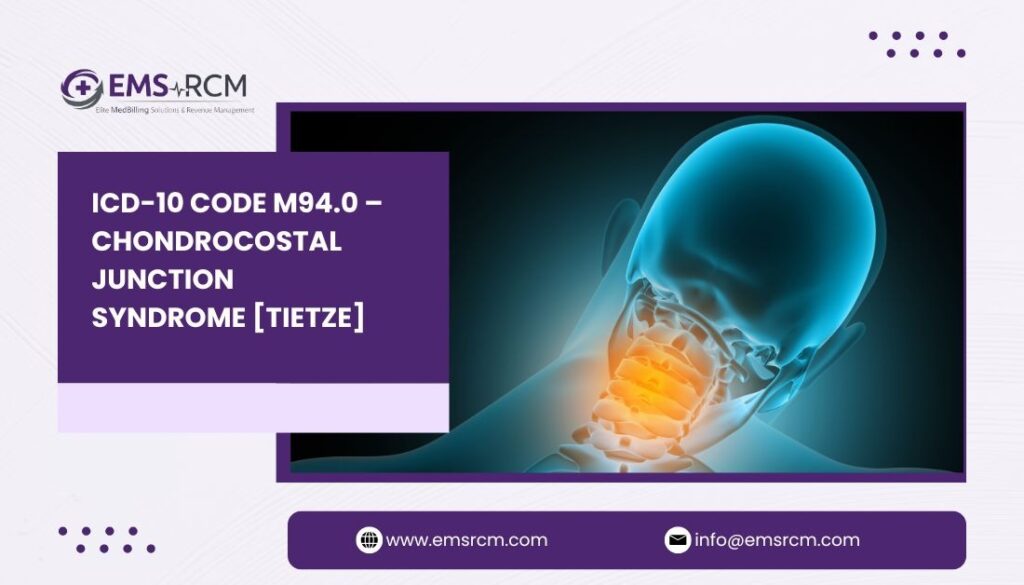
ICD-10 code M94.0 is a billable medical diagnosis code used for healthcare documentation and insurance reimbursement to identify Chondrocostal Junction Syndrome, commonly known as Tietze syndrome. This condition is characterized by inflammation of the costal cartilage, most often at the upper ribs where they attach to the sternum, resulting in localized chest pain, tenderness, and sometimes visible swelling. It is clinically important because the symptoms can closely resemble cardiac-related chest pain, making proper diagnosis essential to rule out more serious conditions such as myocardial infarction or other cardiopulmonary disorders. Accurate documentation and Medical Coding Services also play an important role in ensuring proper diagnosis reporting, treatment tracking, and healthcare reimbursement. Billable Status: YesICD-9 Code Equivalent: 733.6 Clinical Overview Chondrocostal junction syndrome is typically a benign, self-limiting musculoskeletal condition. It most commonly affects the second or third costochondral junction and may be triggered by: Patients usually present with: Read More: ICD-10 Code J20.9 Diagnosis & Evaluation Diagnosis is primarily clinical, based on patient history and physical examination. However, healthcare providers may order tests such as: Treatment Approach Management is generally conservative and may include: Related / Synonyms Read More: ICD-10 Codes R10.0 Clinical Importance for Billing Correct use of ICD-10 code M94.0 ensures: ICD-10 code M94.0 — Chondrocostal Junction Syndrome [Tietze] represents a well-defined, benign musculoskeletal condition that is far more specific than generic “chest wall pain.” The code is HIPAA-valid, billable without additional specificity, and covers a condition with a clear clinical fingerprint: localized swelling at an upper costal cartilage, reproducible on palpation, typically at the 2nd or 3rd rib, almost always unilateral. FAQs: What is the ICD-10 code for Tietze syndrome? ICD-10-CM Code M94.0 is used for Tietze syndrome (Chondrocostal Junction Syndrome). It falls under Other Disorders of Cartilage (M94) and is a billable, HIPAA-compliant code that requires no additional specificity. How is Tietze syndrome different from costochondritis? Tietze syndrome causes chest pain with swelling at the affected rib cartilage, while costochondritis causes chest pain without swelling. Tietze usually affects a single rib junction, is more common in younger people, and has a separate ICD-10 code. How long does Tietze syndrome last? Most cases of Tietze syndrome improve within weeks to months with proper treatment. Some people may experience recurring symptoms, especially with repetitive physical strain, but full recovery without lasting damage is typical.
ICD-10 Code F32.0: Mild Major Depressive Disorder Without Prior Episode
ICD-10 Code F32.0: Mild Major Depressive Disorder Without Prior Episode Depression is one of the most commonly diagnosed mental health conditions worldwide, making accurate clinical documentation and coding essential for patient care, insurance reimbursement, and healthcare reporting. Among the many depression-related diagnosis codes, ICD-10 Code F32.0 is frequently used to document cases of mild depression that occur as a first episode. Whether you’re a healthcare provider, medical coder, billing specialist, student, or patient seeking information, understanding ICD-10 Code F32.0 can help ensure accurate diagnosis reporting and compliance with coding guidelines. What Is ICD-10 Code F32.0? ICD-10 Code F32.0 refers to Major Depressive Disorder, Single Episode, Mild. Quick Definition ICD-10-CM code F32.0 is used when a patient is experiencing a first episode of major depressive disorder with symptoms classified as mild in severity. Code Details Category Information ICD-10 Code F32.0 Diagnosis Major Depressive Disorder, Single Episode, Mild Chapter Mental, Behavioral and Neurodevelopmental Disorders Code Type Billable/Specific ICD-10-CM Code Severity Level Mild Episode Status Single Episode This diagnosis code is considered billable and can be used for reimbursement purposes when supported by proper clinical documentation. Read More: ICD-10 Code J20.9: Acute Bronchitis, Unspecified: Billing and Coding Guide Understanding Mild Major Depressive Disorder Major depressive disorder (MDD) affects a person’s mood, thoughts, behaviors, and daily functioning. In mild cases, symptoms are present but generally cause less severe impairment than moderate or severe depression. Common Symptoms Patients diagnosed with F32.0 may experience: For a diagnosis of major depressive disorder, symptoms typically persist for at least two weeks and represent a noticeable change from the person’s normal functioning. When Is ICD-10 Code F32.0 Used? Healthcare providers may assign F32.0 when: The Patient Has a First Depressive Episode The individual has not previously experienced a documented major depressive episode. Symptoms Are Mild The symptoms exceed normal emotional responses but do not significantly impair the patient’s ability to function independently. Diagnostic Criteria Are Met The patient satisfies the clinical criteria established for major depressive disorder. Clinical Documentation Supports the Diagnosis Medical records should clearly document: Clinical Example of ICD-10 Code F32.0 Example Scenario A 32-year-old office employee reports persistent sadness, reduced motivation, fatigue, and difficulty concentrating for the past month. The symptoms have affected work performance but have not prevented the individual from maintaining employment and daily activities. After evaluation, the healthcare provider diagnoses: Major Depressive Disorder, Single Episode, Mild (F32.0) The provider initiates counseling and recommends lifestyle modifications while monitoring symptom progression. ICD-10 Code F32.0 vs Other Depression Codes Accurate code selection is critical because depression severity and episode status directly influence coding decisions. ICD-10 Code Description F32.0 Major Depressive Disorder, Single Episode, Mild F32.1 Major Depressive Disorder, Single Episode, Moderate F32.2 Major Depressive Disorder, Single Episode, Severe Without Psychotic Features F32.3 Major Depressive Disorder, Single Episode, Severe With Psychotic Features F32.4 Major Depressive Disorder, Single Episode, Partial Remission F32.5 Major Depressive Disorder, Single Episode, Full Remission F33.0 Major Depressive Disorder, Recurrent, Mild Key Difference The most important distinction is that F32.0 represents a single depressive episode, while F33.0 represents recurrent episodes of depression. Documentation Requirements for F32.0 Proper documentation helps support accurate coding and reimbursement. Essential Documentation Elements Healthcare providers should document: Documentation Example The patient presents with persistent low mood, decreased energy, and mild concentration difficulties for four weeks. Symptoms meet criteria for mild major depressive disorder. No prior history of major depressive episodes documented. Common Coding Mistakes to Avoid Coding Mild Depression Without Clinical Support Coders should never assign F32.0 unless documentation clearly supports major depressive disorder criteria. Confusing Single and Recurrent Episodes If the patient has a documented history of previous depressive episodes, a recurrent depression code may be more appropriate. Ignoring Severity Documentation The provider must specify whether depression is mild, moderate, or severe. Assigning a Diagnosis Based Solely on Symptoms Symptoms alone do not justify coding major depressive disorder without a provider diagnosis. Read More: ICD-10 Codes R10.0: Abd Pain Coding Guide Treatment Approaches for Mild Major Depressive Disorder Treatment plans vary depending on patient needs and provider judgment. Common Interventions Early intervention often improves outcomes and may prevent symptom progression. Why Accurate Coding Matters Accurate use of ICD-10 Code F32.0 supports: Better Patient Care Clear diagnosis documentation promotes continuity of treatment across providers. Insurance Reimbursement Correct coding helps reduce claim denials and reimbursement issues. Healthcare Analytics Accurate diagnosis data contributes to population health tracking and quality reporting. Regulatory Compliance Proper coding helps healthcare organizations meet payer and regulatory requirements. Organizations that utilize advanced Medical Coding solution platforms often improve coding accuracy, compliance monitoring, and documentation workflows. Similarly, professional Medical Billing Services can help healthcare practices reduce claim errors and improve revenue cycle performance. Key Takeaways FAQs What does ICD-10 Code F32.0 mean? ICD-10 Code F32.0 indicates Major Depressive Disorder, Single Episode, Mild, meaning the patient is experiencing a first episode of depression with mild symptoms. Is F32.0 a billable ICD-10 code? Yes. F32.0 is a billable and specific ICD-10-CM diagnosis code that can be used for reimbursement when supported by clinical documentation. What is the difference between F32.0 and F33.0? F32.0 describes a single depressive episode, while F33.0 is used when the patient has recurrent episodes of major depressive disorder. What symptoms are associated with F32.0? Common symptoms include sadness, fatigue, sleep disturbances, reduced concentration, loss of interest in activities, and mild impairment in daily functioning. Can F32.0 be used for anxiety and depression together? Not necessarily. If anxiety is also diagnosed, additional diagnosis codes may be required depending on provider documentation and clinical findings. What documentation is needed for F32.0? Documentation should include symptom severity, duration, clinical evaluation findings, functional impairment, diagnosis confirmation, and treatment planning. Conclusion ICD-10 Code F32.0 is used to identify Major Depressive Disorder, Single Episode, Mild, a common mental health diagnosis requiring careful clinical assessment and accurate documentation. Understanding when and how to use this code helps healthcare providers, coders, and billing professionals maintain compliance, support quality patient care, and reduce reimbursement challenges. As coding guidelines continue to evolve, staying informed about depression-related
ICD-10 Code J20.9: Acute Bronchitis, Unspecified: Billing and Coding Guide
Acute bronchitis is one of the most commonly diagnosed respiratory conditions in clinical practice, especially during seasonal viral outbreaks. When healthcare providers document acute bronchitis but do not specify the causative organism, ICD-10 Code J20.9 is often assigned. This guide explains exactly what ICD-10 Code J20.9 (Acute Bronchitis, Unspecified) means, when it should be used, clinical documentation requirements, coding considerations, reimbursement implications, and common mistakes healthcare practices should avoid. Whether you are a medical coder, biller, healthcare administrator, or provider, understanding this code can help reduce claim denials and improve coding accuracy. What Is ICD-10 Code J20.9? ICD-10 Code J20.9 refers to Acute Bronchitis, Unspecified. It is used when a patient is diagnosed with acute bronchitis, but the documentation does not identify the infectious organism or specific cause. Quick definition Category Details ICD-10 Code J20.9 Description Acute bronchitis, unspecified Chapter Diseases of the Respiratory System (J00–J99) Condition Type Acute respiratory illness Billable Code Yes Common Use Medical diagnosis and insurance claim reporting This code falls under the broader category of acute lower respiratory infections and is considered a billable ICD-10-CM diagnosis code. Key Takeaway Use J20.9 when acute bronchitis is documented but no specific organism (viral, bacterial, or other cause) is identified. Understanding Acute Bronchitis Acute bronchitis occurs when the bronchial tubes become inflamed, leading to irritation and increased mucus production. It often develops after viral upper respiratory infections. Most cases are temporary and improve within several weeks. Common symptoms include: Symptoms can vary in severity depending on: When Should ICD-10 Code J20.9 Be Used? J20.9 should be assigned when: Example Provider note: “The patient presents with a productive cough, wheezing, and chest congestion for five days. Diagnosed with acute bronchitis.” Since no organism is identified: Appropriate code: J20.9 When J20.9 Should Not Be Used Incorrect coding creates reimbursement problems and increases audit risk. Do not use J20.9 when documentation identifies a specific infectious agent. Examples include: Condition Possible ICD-10 Alternative Acute bronchitis due to Mycoplasma pneumoniae J20.0 Acute bronchitis due to Haemophilus influenzae J20.1 Acute bronchitis due to streptococcus J20.2 Acute bronchitis due to coxsackievirus J20.3 Chronic bronchitis Different chronic respiratory codes Bronchiolitis Separate diagnosis category Specificity generally improves coding accuracy and reduces payer scrutiny. Read More: ICD-10 Codes R10.0: Abd Pain Coding Guide Clinical Documentation Requirements for J20.9 Strong clinical documentation supports clean claims and minimizes coding disputes. Providers should document: Patient presentation Clinical assessment Treatment plan Supporting documentation example Good documentation: “The patient reports a productive cough lasting seven days with mild wheezing and chest congestion. Examination supports diagnosis of acute bronchitis. No specific organism identified.” Common Coding Mistakes With ICD-10 J20.9 Even experienced coding teams encounter avoidable errors. 1. Coding before diagnostic confirmation Symptoms alone do not justify J20.9. Avoid assigning: 2. Ignoring provider specificity Documentation may identify a causative organism later through testing. If the organism becomes known: 3. Missing related conditions Patients frequently present with: Additional diagnosis codes may be necessary. ICD-10 J20.9 and Medical Billing Considerations Diagnosis coding directly affects reimbursement outcomes. Accurate use of J20.9 supports: Healthcare organizations often use specialized Medical Coding service solutions to improve diagnosis accuracy and maintain compliant coding practices. Similarly, integrated Medical Billing services workflows can help reduce administrative inefficiencies and support timely reimbursements. Documentation Checklist for Providers and Coders Use this checklist before claim submission: Acute Bronchitis Coding Checklist J20.9 vs Specified Acute Bronchitis Codes Understanding the distinction helps improve specificity. Feature J20.9 Specified Acute Bronchitis Codes Organism identified No Yes Documentation specificity Lower Higher Claim clarity Moderate Strong Audit preference Less favorable More favorable Coding precision General Detailed Real-World Scenario A patient arrives with: The physician documents: “Acute bronchitis.” No organism is identified. Correct ICD-10 assignment: J20.9 If later testing reveals a specific pathogen, coding should be updated accordingly. Read More: ICD-10 Code G43.909: Migraine, Unspecified Why Specific Documentation Matters More Than Many Practices Realize One issue many coding discussions overlook is that unspecified diagnosis codes are not automatically wrong. Using J20.9 can be entirely appropriate when: Problems arise when specificity exists but is not captured. Modern payer analytics increasingly identify documentation gaps and coding inconsistencies. Small omissions can lead to: Key Takeaways FAQs Is ICD-10 Code J20.9 billable? Yes. J20.9 is a billable ICD-10-CM diagnosis code and may be used for reimbursement purposes when documentation supports its use. What does “unspecified” mean in J20.9? “Unspecified” indicates that the medical record does not identify the specific organism or cause responsible for acute bronchitis. Can J20.9 be used for viral bronchitis? Only if the provider documents acute bronchitis without identifying a specific viral organism. If the virus is specified, a more detailed code may apply. Can J20.9 be assigned from symptoms alone? No. Symptoms such as cough or congestion are not sufficient. A provider must document acute bronchitis as the diagnosis. Is acute bronchitis the same as chronic bronchitis? No. Acute bronchitis is short-term inflammation that typically resolves within weeks, while chronic bronchitis is a long-term condition commonly associated with chronic respiratory disease. How can practices reduce coding errors related to J20.9? Practices can improve accuracy by: Final Thoughts ICD-10 Code J20.9 plays an important role in accurately reporting acute bronchitis cases when a specific cause has not been identified. The code itself is straightforward, but successful use depends on strong documentation and careful coding review. For providers and healthcare organizations, the focus should not simply be selecting a diagnosis code, it should be ensuring the medical record clearly reflects the patient’s condition and supports reimbursement requirements.As coding standards evolve, reviewing documentation practices regularly can help maintain accuracy, reduce denials, and strengthen revenue cycle performance.
ICD-10 Code S30.860A – Insect Bite (Nonvenomous): Medical Coding Guide 2026
Insect bites are among the most common minor injuries treated in clinical and outpatient settings. However, accurate documentation and coding are essential to ensure proper reimbursement and avoid claim denials. One frequently used code in dermatology and emergency care is ICD-10 Code S30.860A, which represents a nonvenomous insect bite of the lower back and pelvis, initial encounter. This guide explains everything you need to know about this ICD-10 code, including its meaning, documentation requirements, billing guidelines, and common coding mistakes. What Is ICD-10 Code S30.860A? ICD-10 Code S30.860A is used to classify a nonvenomous insect bite affecting the lower back and pelvis area, specifically during the initial encounter for treatment. Code Breakdown: This code is part of the ICD-10-CM classification system used in the United States for diagnosis coding and insurance billing. Clinical Description of S30.860A A nonvenomous insect bite typically includes bites from: Common symptoms include: Unlike venomous bites or stings, these do not involve systemic toxicity or severe allergic reactions. When to Use ICD-10 Code S30.860A Use this code when: Do NOT use this code if: ICD-10 Coding Guidelines for S30.860A Accurate documentation is essential for clean claim submission. Key documentation requirements: Encounter classification: Encounter Type ICD-10 Extension Meaning Initial visit A Active treatment Subsequent visit D Routine healing follow-up Sequela S Late effects Common Coding Mistakes to Avoid Medical coders often make errors that lead to claim denials. Avoid the following: Why Accurate Coding Matters in Insect Bite Cases Proper ICD-10 coding ensures: Even minor skin conditions like insect bites can impact revenue cycle performance when coded incorrectly. For healthcare providers looking to improve accuracy and reduce denials, professional Medical Billing Services can streamline documentation, coding, and claim submission processes efficiently. Related ICD-10 Codes You Should Know ICD-10 Code Description S30.860D Nonvenomous insect bite, subsequent encounter S30.860S Sequela of insect bite T63.4 Toxic effect of insect venom L29.9 Pruritus, unspecified FAQs 1. What does ICD-10 code S30.860A mean? It refers to a nonvenomous insect bite located on the lower back and pelvis during the initial treatment visit. 2. Is S30.860A used for mosquito bites? Yes, if the mosquito bite is nonvenomous and affects the specified anatomical region. 3. What is the difference between venomous and nonvenomous insect bites in ICD-10 coding? Venomous bites may require toxicity-related codes, while nonvenomous bites use localized injury codes like S30.860A. 4. Can S30.860A be used for follow-up visits? No. For follow-up care, you must use the appropriate subsequent encounter code (S30.860D). 5. What documentation is required for this ICD-10 code? You need the bite location, insect type (if known), symptom description, and encounter type. Summary ICD-10 Code S30.860A plays an important role in documenting and billing nonvenomous insect bites affecting the lower back and pelvic region. Proper use of this code requires accurate documentation, correct encounter selection, and awareness of coding guidelines. By understanding its structure and application, healthcare providers and coders can ensure smoother claim processing and improved revenue cycle performance. Accurate coding is the foundation of efficient healthcare billing. If your practice struggles with claim denials or documentation errors, optimizing your coding workflow or partnering with expert billing support can make a measurable difference in revenue and compliance. Partner with Elite MedBilling Solutions to streamline your coding process, reduce denials, and strengthen your practice’s revenue cycle.