Every dollar a practice writes off to bad debt didn’t disappear because a patient refused to pay, in most cases, it disappeared somewhere between claim adjudication and the mailbox. A confusing statement, a missed cycle, a balance sent too late to feel connected to the visit: these are operational failures, not payment failures. And they show up directly on the bottom line.
If you manage billing operations, sit on a revenue cycle team, or run a practice that’s watching self-pay collections slide, this guide breaks down the patient statement in medical billing from the operational side: how the statement fits into the revenue cycle, what a compliant and collectible statement actually contains, how statement cycles are built, where practices lose money in the process, and what a modern, automated statement workflow looks like in 2026.
What Is a Patient Statement in Medical Billing?
A patient statement in medical billing is the billing document a healthcare provider sends to a patient after the insurance payer has finished adjudicating a claim, showing the remaining balance the patient owes. It’s generated after payment posting, once the practice has applied the insurer’s payment, contractual adjustments, and any prior patient payments to the account, and it functions as the formal request for the patient’s portion of the bill.
Quick definition: A patient statement is the post-adjudication invoice that converts a patient’s outstanding responsibility (deductible, copay, coinsurance, or non-covered charges) into a payable balance with a due date.
It’s the final output of a process that starts with charge capture and ends with either payment, a payment plan, or a placement in collections. Everything upstream in the revenue cycle, coding accuracy, clean claim submission, denial resolution, correct payment posting, determines whether the statement that lands in a patient’s inbox is even correct in the first place.
Related read: For a patient-facing breakdown of what’s on a statement and how to read one, see our companion guide, What Is a Patient Statement? A Complete Guide for Patients and Healthcare Providers.
Where the Patient Statement Sits in the Revenue Cycle
A statement isn’t a standalone document, it’s the last checkpoint in a chain of dependent steps. Understanding that sequence explains most of the collection problems practices run into.
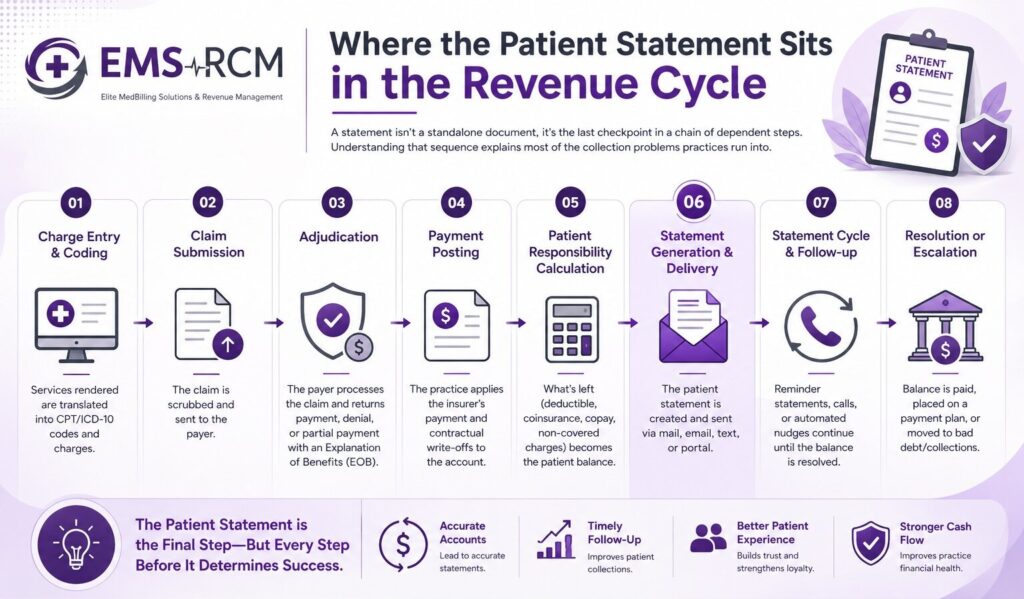
- Charge entry & coding – Services rendered are translated into CPT/ICD-10 codes and charges.
- Claim submission – The claim is scrubbed and sent to the payer.
- Adjudication – The payer processes the claim and returns payment, denial, or partial payment with an Explanation of Benefits (EOB).
- Payment posting – The practice applies the insurer’s payment and contractual write-offs to the account.
- Patient responsibility calculation – What’s left (deductible, coinsurance, copay, non-covered charges) becomes the patient balance.
- Statement generation & delivery – The patient statement is created and sent via mail, email, text, or portal.
- Statement cycle & follow-up – Reminder statements, calls, or automated nudges continue until the balance is resolved.
- Resolution or escalation – Balance is paid, placed on a payment plan, or moved to bad debt/collections.
A weak link anywhere upstream, a delayed claim, a denial that sits unworked, a posting error, pushes the wrong number, or the wrong timing, onto that statement. That’s why practices with strong denial management and accurate payment posting processes consistently see cleaner, faster-paying statements than practices that treat billing as a series of disconnected tasks.
What Information a Compliant Patient Statement Must Include
Formats vary by practice management system, but a defensible, collectible statement should always contain the following.
| Field | Purpose |
| Patient & account information | Identifies the account without ambiguity |
| Provider/practice information | Name, address, and billing department contact |
| Date(s) of service | Ties the charge to a specific visit |
| Services rendered | Plain-language description of procedures |
| Total charges | Original billed amount before adjustments |
| Insurance payments | Amount the payer contributed |
| Contractual adjustments | Write-offs required by the payer contract |
| Prior patient payments | Copays or payments already applied |
| Patient responsibility | The actual amount owed |
| Due date | Payment deadline for that cycle |
| Payment options | Online portal, phone, mail, or in-person |
Example — how a balance is actually built:
| Line Item | Amount |
| Office Visit | $220 |
| Laboratory Test | $90 |
| Total Charges | $310 |
| Insurance Paid | –$240 |
| Contractual Adjustment | –$30 |
| Patient Balance | $40 |
Statements that skip the “why” showing only a final number with no breakdown, generate a disproportionate share of billing office phone calls. Every line a patient has to call and ask about is a line that slows down payment.
Patient Statement vs. Medical Bill vs. Superbill: Know the Difference
Inside a billing department, these terms get used loosely, but they aren’t interchangeable, and mixing them up in patient-facing communication creates confusion and compliance risk.
| Document | Sent By | Sent When | Reflects Final Balance? |
| Superbill / charge slip | Provider | At time of service | No, pre-adjudication |
| Initial medical bill | Provider | Before or shortly after the visit | Sometimes, estimate only |
| Patient statement | Provider | After insurance adjudication | Yes |
| Explanation of Benefits (EOB) | Insurance company | After claim processing | No — not a bill, an explanation |
The distinction that trips up the most practices: an EOB is not a bill, and patients frequently pay the wrong document, ignore a real statement because they assume it’s redundant with the EOB, or call in confused about why two different numbers exist. Statement language that explicitly says “This is a bill — payment is due” versus “This is not a bill” (standard EOB language) reduces that confusion significantly.
How Statement Cycles Are Built
Most practices don’t send one statement and stop — they run a statement cycle, a sequence of touchpoints designed to move a balance to zero without damaging the patient relationship. A typical cycle looks like this:
- Day 0 — First statement generated and sent (mail, email, and/or text, depending on patient preference)
- Day 30 — Second statement/reminder if unpaid, often with a slightly firmer tone
- Day 60 — Third statement, may include a courtesy call or automated reminder
- Day 90 — Final notice before the account is flagged for a payment plan offer or collections placement
The number of touches, the channel mix, and the tone at each stage are usually configurable, and they matter. Practices that only mail a single paper statement and wait see meaningfully lower response rates than those running a multi-channel cycle with text and email reminders layered in.
Key metrics RCM teams should track across the cycle:
- Self-pay collection rate (percentage of patient balances collected within 90 days)
- Average days to payment after first statement
- Statement response rate by channel (mail vs. email vs. text vs. portal)
- Cost to collect per statement
- Percentage of balances requiring more than two statements
Common Reasons a Patient Receives a Statement
A statement showing up doesn’t automatically mean something went wrong upstream. Typical triggers include:
- Deductible not yet met for the plan year
- Coinsurance or copay owed per the plan’s terms
- Services the plan doesn’t cover
- Out-of-network charges
- A balance remaining after a partial insurance payment
- A correction or adjustment applied after an earlier statement
Where it does signal an upstream problem: statements triggered by claim denials that were never appealed, coding errors that inflated the patient’s share, or payment posting mistakes. That’s the segment worth auditing first when self-pay A/R starts climbing, it’s often a workflow issue, not a patient behavior issue.
Where Practices Lose Money in the Statement Process
Highlight box — the most common failure points:
- Delayed statements. The longer the gap between the visit and the statement, the less connected the patient feels to the charge, and the lower the response rate.
- Confusing balances. Statements that show a final number without the insurance payment, adjustment, and prior payment breakdown generate calls instead of payments.
- Single-channel delivery. Paper-only statements underperform against a mail + email + text + portal mix, especially with younger patient populations.
- No self-service payment path. Every extra step between “I want to pay” and “I paid” costs conversions, a QR code or one-click portal link matters more than it seems.
- Manual, understaffed follow-up. Statements that go out but are never systematically re-sent or escalated quietly age into bad debt.
- Compliance gaps. Inconsistent messaging around collections timelines, missing itemization, or statement language that runs afoul of state billing-notice requirements creates legal exposure on top of lost revenue.
Best Practices for Managing Patient Statements
Checklist for billing teams and practice administrators:
- Generate and send the first statement within days of payment posting, not weeks
- Break down every line , charges, insurance paid, adjustments, balance — rather than showing a single number
- Offer at least three payment channels: online portal, phone, and mail/check
- Support digital delivery (email/text) alongside paper for patients who opt in
- Build a defined statement cycle (e.g., day 0 / 30 / 60 / 90) with escalating tone
- Automate reminders so follow-up doesn’t depend on staff bandwidth
- Include a clear, direct contact line for billing questions
- Offer payment plans before escalating to collections
- Audit statement accuracy against the EOB before it goes out the door
- Review statement language annually against current state and federal billing-notice requirements
Compliance Considerations for Patient Statements
Patient billing communication sits under more regulatory scrutiny than it used to. A few areas worth building into any statement workflow:
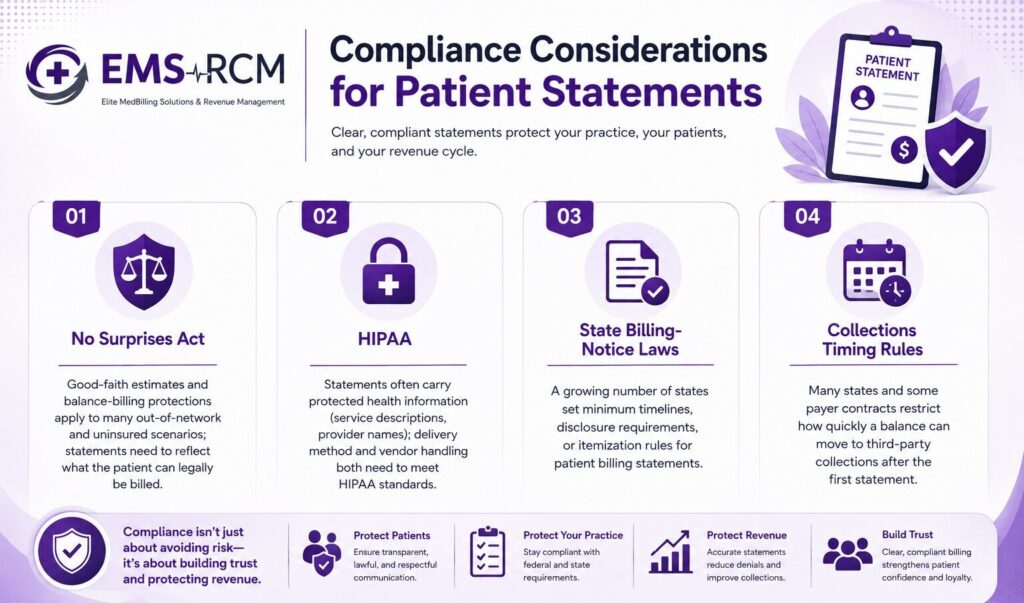
- No Surprises Act — Good-faith estimates and balance-billing protections apply to many out-of-network and uninsured scenarios; statements need to reflect what the patient can legally be billed.
- HIPAA — Statements often carry protected health information (service descriptions, provider names); delivery method and vendor handling both need to meet HIPAA standards.
- State billing-notice laws — A growing number of states set minimum timelines, disclosure requirements, or itemization rules for patient billing statements.
- Collections timing rules — Many states and some payer contracts restrict how quickly a balance can move to third-party collections after the first statement.
None of this needs to be a barrier to fast, effective collections, it just needs to be built into the statement cycle by design rather than bolted on after a complaint.
How Technology Is Changing Patient Statements
The manual, print-and-mail-only statement process is increasingly a competitive disadvantage. Practices moving to modern statement workflows are typically combining:
- Automated batch statement generation tied directly to payment posting, so statements go out on a consistent schedule without manual triggers
- Multi-channel delivery — mail, email, SMS, and patient portal, matched to each patient’s stated preference
- Online and mobile payment portals with saved payment methods and one-click pay
- Text-to-pay and QR-code payment links embedded directly in the statement
- Payment plan automation that offers installment options before a balance ages into collections
- Real-time reporting dashboards tracking statement response rates, days-to-pay, and cost-to-collect by channel
The practices seeing the biggest gains aren’t necessarily sending more statements, they’re sending better-timed, better-formatted, easier-to-pay statements and letting automation handle the follow-up cadence that used to depend on a billing staffer remembering to hit send.
When to Outsource Patient Statement Services
In-house teams often manage statements fine at low volume, but the workload scales faster than most practices expect: more patients, higher deductibles, more payer plans, and more channels to manage all compound at once. Signs it’s time to bring in dedicated support include:
- Self-pay A/R is aging past 90 days at a growing rate
- Billing staff spend more time on statement production than on denial follow-up or coding accuracy
- Statements go out inconsistently or fall behind after payment posting
- Patients report confusion or call the office more than they pay online
- There’s no reliable reporting on statement performance
Outsourcing this piece doesn’t mean losing visibility, it means the statement cycle runs on a defined schedule, across multiple channels, with reporting attached, while your internal team stays focused on clinical operations and higher-value medical billing and A/R follow-up work.
Key Takeaways
- A patient statement is generated after insurance adjudication and reflects the patient’s true remaining balance.
- It’s the final checkpoint of the revenue cycle, accuracy upstream (coding, claims, payment posting) directly determines statement accuracy.
- Clear, itemized statements with multiple payment channels collect faster and generate fewer billing calls.
- A structured statement cycle (with defined touchpoints and escalating reminders) outperforms single-notice billing.
- Compliance, No Surprises Act, HIPAA, and state billing-notice rules, needs to be built into statement design, not addressed after a complaint.
- Automation and multi-channel delivery are now the baseline for competitive self-pay collection rates, not a differentiator.
FAQs
What is a patient statement in medical billing?
It’s the billing document sent to a patient after insurance has processed a claim, showing the remaining balance owed after payments and adjustments, separate from an initial bill or an EOB.
How is a patient statement different from an EOB?
An EOB comes from the insurance company and explains how a claim was processed; it’s not a bill and doesn’t require payment. A patient statement comes from the provider and is the actual request for payment.
How long after a visit should a patient statement be sent?
As soon as possible after payment posting is complete — typically within a few days. Statement timing usually falls two to eight weeks after the visit, depending on how quickly the payer adjudicates the claim.
Why do patient statements sometimes seem to arrive twice or with different amounts?
This usually happens when a claim is reprocessed, a correction or additional insurance payment is applied, or the account moves into a new statement cycle stage. It doesn’t necessarily indicate an error.
Can a patient statement be sent electronically instead of by mail?
Yes. Most modern statement workflows offer email, text, and patient portal delivery alongside traditional mail, and many patients prefer digital delivery when it’s offered.
What should a practice do if patients frequently call with questions about their statement?
High call volume around statements is usually a formatting problem, not a patient problem, it typically means the statement isn’t itemized clearly enough or doesn’t explain the balance in plain language.
Turning Statements Into Predictable Revenue
The patient statement isn’t paperwork at the end of the billing process, it’s the last real chance to collect a balance without letting it age into bad debt. Practices that treat it as a designed, automated, multi-channel workflow consistently out-collect practices still running a single mailed notice and hoping for the best.
If self-pay collections have been slipping, or your team is spending more time producing statements than working denials, EMSRCM’s Patient Statement Services are built to take that workload off your plate, accurate, itemized, multi-channel statements tied directly into your broader revenue cycle. Contact our team to see how a structured statement cycle fits into your practice’s billing operations.