
A patient statement is more than a request for payment. It is an important communication tool that explains what a patient owes after healthcare services have been provided and the insurance billing process has been completed.
The purpose of patient statements is to clearly communicate the patient’s financial responsibility, provide enough information to understand the balance, and give the patient a practical way to pay or resolve questions about the account.
For medical practices, hospitals, and other healthcare organizations, well-designed patient statements support a healthier revenue cycle while reducing confusion and unnecessary billing inquiries. For patients, a clear statement can make an otherwise complicated healthcare bill easier to understand.
This guide explains what patient statements are, why they matter, what information they should contain, how they fit into the medical billing process, and how providers can improve the patient billing experience.
What Is the Purpose of Patient Statements?
The primary purpose of a patient statement is to inform a patient about the amount they owe for healthcare services and explain how that balance was calculated.
A patient statement is generally generated after the provider has processed the applicable insurance claim and posted the insurer’s payment, adjustments, and other account activity.
A statement may communicate:
- The date or dates of service
- The healthcare services provided
- Charges associated with those services
- Insurance payments
- Contractual adjustments
- Deductible amounts
- Copayments
- Coinsurance
- Previous payments
- Credits or adjustments
- The remaining patient balance
- Payment due information
- Available payment methods
- Billing department contact information
The exact format varies by provider, payer, state, and billing system.
Key takeaway: A patient statement turns the results of the medical billing process into a patient-facing financial summary. Its job is not simply to collect money; it is also to explain the balance and help the patient understand what to do next.
Why Are Patient Statements Important?
Healthcare billing involves multiple parties, including patients, providers, health plans, clearinghouses, and billing teams. The amount initially charged by a provider is often not the same as the amount ultimately owed by the patient.
This is where patient statements become important.
A statement creates a clear connection between the healthcare services received, insurance processing, and the patient’s remaining financial responsibility.
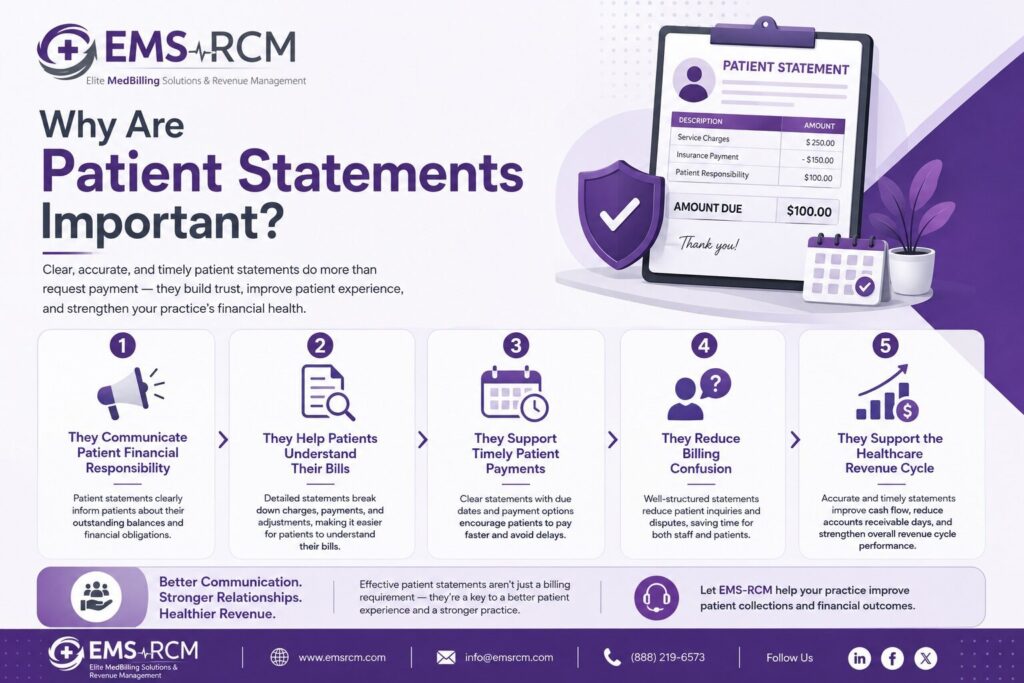
1. They Communicate Patient Financial Responsibility
The most obvious purpose is to tell the patient what remains unpaid.
For an insured patient, the balance may result from:
- A deductible
- Coinsurance
- A copayment
- A non-covered service
- An insurance denial
- A service subject to plan limitations
- An amount not paid by the health plan
The statement should make the outstanding balance easy to identify.
2. They Help Patients Understand Their Bills
A patient may receive several pieces of financial information after receiving care. One of the most important is the Explanation of Benefits (EOB).
An EOB is not a bill. CMS explains that an EOB shows how the health plan processed a claim, including provider charges, allowed charges, insurer payments, and the amount identified as the patient’s responsibility.
The provider’s statement is different: it communicates the amount the provider is requesting from the patient.
This distinction matters because patients may otherwise confuse an EOB with an actual bill.
3. They Support Timely Patient Payments
A patient cannot reasonably be expected to pay an amount they cannot identify or understand.
A clear statement should answer three basic questions:
- What am I being charged for?
- How much do I owe?
- How can I pay or ask questions?
When those answers are easy to find, the statement becomes a practical payment tool rather than a confusing financial document.
4. They Reduce Billing Confusion
Patients may contact a practice because they do not understand why a balance exists.
For example, a patient may see:
- Provider charges: $300
- Insurance payment: $180
- Insurance adjustment: $60
- Patient responsibility: $60
Without context, the patient may assume they owe $300.
A properly designed statement makes the financial outcome easier to follow.
5. They Support the Healthcare Revenue Cycle
Patient responsibility represents an important part of provider revenue.
After insurance adjudication, the remaining balance may need to be collected from the patient. Patient statements provide one of the primary communication channels for that collection process.
That makes statement accuracy, timing, readability, and payment accessibility important parts of the overall revenue cycle.
How Do Patient Statements Work in Medical Billing?
Understanding the purpose of patient statements becomes easier when you look at where they appear in the revenue cycle.
A typical workflow looks like this:
Patient receives care → Provider documents services → Claim is submitted → Insurance processes claim → Payment and adjustments are posted → Patient responsibility is calculated → Patient statement is generated → Patient pays or contacts billing
Step-by-Step Patient Statement Process

Step 1: The Patient Receives Healthcare Services
The process begins when a patient receives services such as:
- Office visits
- Diagnostic testing
- Laboratory services
- Imaging
- Procedures
- Hospital services
- Therapy
- Preventive care
The provider records the services and relevant billing information.
Step 2: The Provider Submits the Insurance Claim
For insured patients, the provider generally submits a claim to the patient’s health plan.
The claim contains information necessary for the payer to process the services.
Step 3: The Insurance Company Processes the Claim
The payer evaluates the claim according to the patient’s benefits, contractual rules, coverage, and applicable policies.
The insurer may:
- Pay part of the claim
- Apply an amount to the deductible
- Assign coinsurance
- Apply a copayment
- Deny a service
- Apply contractual adjustments
- Request additional information
Step 4: The Provider Posts the Insurance Response
Once the payer response is received, the provider’s billing system records the payment and applicable adjustments.
This step is important because the patient statement should reflect the account after relevant insurance activity has been posted.
Step 5: The Patient Balance Is Determined
The remaining amount becomes the patient’s financial responsibility when applicable.
The amount can vary significantly depending on the patient’s insurance plan and the services received.
Step 6: The Patient Statement Is Generated
The provider then generates a statement showing the remaining balance and information needed for payment or account inquiries.
Step 7: The Patient Pays or Contacts the Provider
The patient can pay the balance using the payment options offered by the provider or contact the billing department if the amount appears incorrect or requires clarification.
CMS advises patients to compare their bills with their EOB and contact the provider or facility if they believe there is an error.
What Information Should a Patient Statement Include?
A useful patient statement should provide enough information for the patient to recognize the account and understand the balance.
Although formats differ, a comprehensive statement commonly includes the following:
| Statement Element | Purpose |
| Patient name | Identifies the account |
| Account number | Helps billing staff locate the account |
| Date of service | Shows when care was provided |
| Provider information | Identifies the healthcare organization |
| Service description | Helps the patient recognize the service |
| Original charges | Shows the amount billed |
| Insurance payment | Shows amounts paid by the payer |
| Adjustments | Shows applicable reductions or contractual adjustments |
| Patient payments | Reflects amounts already paid |
| Current balance | Shows the amount currently due |
| Due date | Provides payment timing information |
| Payment instructions | Explains how to make a payment |
| Contact information | Gives patients a way to ask questions |
The goal is not to overwhelm patients with billing terminology. The goal is to provide enough information to make the balance understandable.
Patient Statement vs. Explanation of Benefits
One of the most common sources of patient confusion is the difference between a provider statement and an Explanation of Benefits.
They are related, but they are not the same document.
| Patient Statement | Explanation of Benefits (EOB) |
| Usually comes from the provider or billing organization | Comes from the health plan |
| Communicates an amount the provider says is due | Explains how the insurer processed the claim |
| Used to facilitate payment | Used to explain insurance claim adjudication |
| May contain payment instructions | Usually does not function as the provider’s payment request |
| Focuses on the patient’s account balance | Focuses on insurance coverage and claim processing |
CMS specifically states that an EOB is not a bill. It helps patients understand how much their health plan covers and what they may owe when they receive a provider bill.
Example
Imagine a provider submits a $500 claim.
The health plan determines:
- Provider charges: $500
- Allowed amount: $350
- Insurance payment: $250
- Patient responsibility: $100
The EOB explains how the insurer arrived at the $100 patient responsibility.
The provider statement then communicates the provider’s request for the applicable $100 balance, assuming the account is otherwise accurate and no additional patient payment has already been posted.
What Are the Benefits of Clear Patient Statements?
Effective patient statements can benefit both patients and healthcare organizations.
Benefits for Patients
Clear statements can provide:
- Better understanding of healthcare costs
- Easier identification of services
- Greater transparency around patient responsibility
- Convenient payment instructions
- Easier access to billing support
- Less uncertainty about outstanding balances
Benefits for Providers
For healthcare organizations, effective patient statements can contribute to:
- More efficient patient collections
- Fewer avoidable billing calls
- Better account communication
- Improved revenue cycle visibility
- Fewer misunderstandings about balances
- A more consistent patient financial experience
The important point is that patient collections should not be separated from patient communication.
A statement that asks for payment without explaining the balance may create friction. A statement that communicates clearly can help the patient understand what happened financially after receiving care.
What Makes a Good Patient Statement?
A patient statement should be designed around the patient’s questions rather than the billing system’s internal structure.
1. Make the Balance Obvious
The current amount due should be easy to locate.
Avoid forcing patients to search through multiple sections to determine what they owe.
2. Use Plain Language
Medical billing already contains unfamiliar terminology.
Where possible, statements should use understandable language and explain necessary billing terms.
For example, “Amount You Owe” may be easier for many patients to understand than an unexplained internal accounting label.
3. Explain the Date of Service
Patients should be able to connect the balance to an actual healthcare encounter.
This becomes especially important when a patient has multiple visits or receives statements for several services.
4. Provide Payment Options
Depending on the provider’s system, patients may be able to pay through:
- Online portals
- Credit or debit cards
- Electronic payment methods
- Telephone payments
- In-person payments
The statement should clearly explain available options.
5. Make Questions Easy to Ask
A statement should provide an appropriate billing contact method.
Patients should not have to search the provider’s entire website to find out whom to contact about a billing question.
6. Avoid Unnecessary Complexity
A technically accurate statement can still be difficult to understand.
The best patient-facing documents translate complicated revenue cycle information into a simple financial explanation.
What Is the Purpose of Patient Statements in Medical Billing?
In patient statements in Medical Billing, the purpose is to communicate the patient’s remaining financial responsibility after the relevant billing and insurance processes have been applied.
Patient statements connect back-office revenue cycle activities with the patient’s financial experience.
They can communicate the outcome of:
- Charge capture
- Medical coding
- Claim submission
- Insurance adjudication
- Payment posting
- Contractual adjustments
- Patient responsibility calculation
- Prior patient payments
This makes statement generation more than an administrative task.
It is the final patient-facing stage of a much larger billing process.
What Causes a Patient Balance?
A patient statement does not necessarily mean that the provider made an error or that insurance failed to pay.
Patient balances can occur for many legitimate reasons.
Common reasons include:
Deductible:
The patient may be responsible for covered expenses until reaching the deductible specified by the health plan.
Copayment:
A fixed amount may be due for certain services.
Coinsurance:
The patient may owe a percentage of the allowed cost after applicable plan requirements are met.
Non-covered services:
A service may not be covered under the patient’s plan, depending on the circumstances.
Insurance limitations:
Coverage may have specific restrictions or benefit limits.
Uninsured or self-pay care:
A patient who does not use insurance may be responsible for the provider’s applicable charges.
Claim denial:
A denied claim may sometimes result in a patient balance, although whether the patient is responsible depends on the reason for denial, payer rules, contracts, applicable law, and the circumstances of the service.
That last distinction is important: a denied claim does not automatically mean the patient should be billed.
Patient Statements and Healthcare Transparency
Patient statements have become increasingly important as patients take a more active role in understanding healthcare costs.
For uninsured or self-pay patients, federal requirements can also affect the relationship between expected charges and final bills.
Under the No Surprises Act, providers and facilities generally must provide a Good Faith Estimate to uninsured or self-pay patients in specified circumstances. CMS explains that a Good Faith Estimate is an estimate of expected charges and is not itself a bill.
CMS also provides a patient-provider dispute resolution process for eligible uninsured or self-pay individuals whose bills are at least $400 higher than the applicable Good Faith Estimate, subject to the program’s requirements.
This highlights an important distinction:
An estimate is not a statement, and an EOB is not a statement.
Each document serves a different purpose within the healthcare financial journey.
Patient Statement vs. Medical Bill
The terms “patient statement” and “medical bill” are often used interchangeably in everyday conversation.
From an operational perspective, however, a patient statement is typically a patient-facing account document that communicates the balance due and related account information.
A medical bill is the broader concept of a request for payment for healthcare services.
In practice, organizations may use terms such as:
- Patient statement
- Billing statement
- Medical bill
- Patient bill
- Patient account statement
The terminology can vary by organization and billing platform.
What matters most is whether the document clearly communicates the financial obligation and provides accurate information.
Common Problems With Patient Statements
Even when the underlying billing is correct, the statement itself can create confusion.
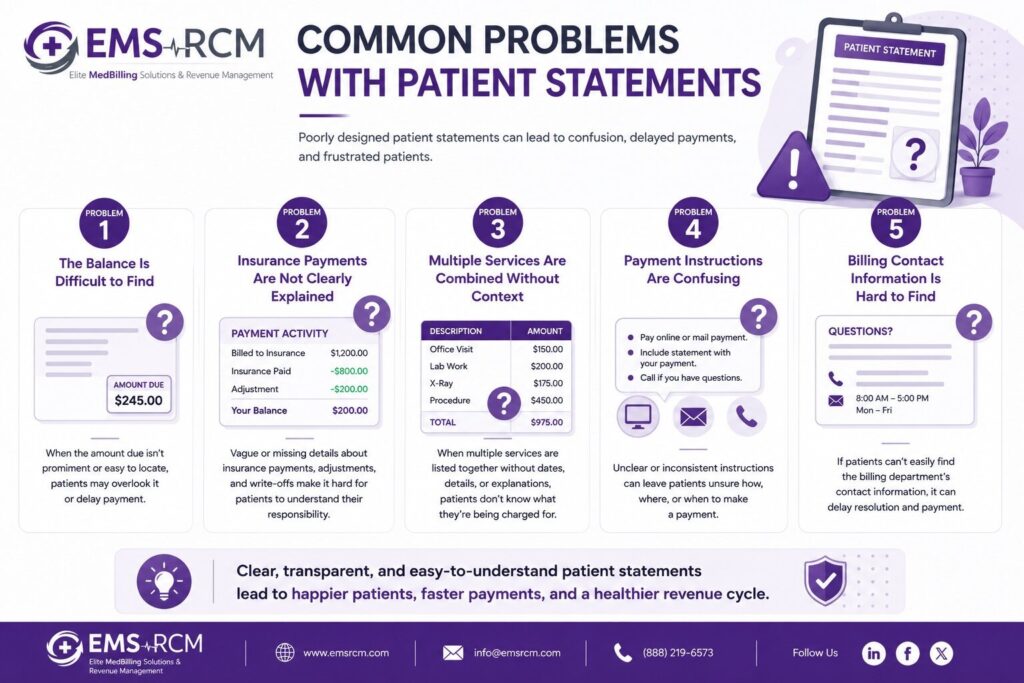
Problem 1: The Balance Is Difficult to Find
If the amount due is buried among account details, patients may struggle to determine what action is required.
Better approach: Place the current balance and payment instructions in a prominent location.
Problem 2: Insurance Payments Are Not Clearly Explained
Patients may see a charge and assume they owe the entire amount.
Better approach: Clearly distinguish charges, insurance payments, adjustments, and patient responsibility.
Problem 3: Multiple Services Are Combined Without Context
A statement covering several encounters can be difficult to interpret.
Better approach: Organize charges by date of service or encounter where appropriate.
Problem 4: Payment Instructions Are Confusing
Patients may want to pay but not know which payment channel to use.
Better approach: Provide simple, visible instructions.
Problem 5: Billing Contact Information Is Hard to Find
A patient who questions a balance needs a clear path to assistance.
Better approach: Include an accessible phone number, portal option, or other appropriate contact method.
How Can Medical Practices Improve Patient Statements?
Improving patient statements is not simply a design exercise. It requires coordination between billing operations, technology, compliance, and patient experience.
Patient statement improvement checklist
Before sending a statement, organizations can evaluate whether it:
- Shows the correct patient and account
- Reflects current account activity
- Shows relevant dates of service
- Clearly identifies the current balance
- Correctly reflects posted insurance payments
- Includes applicable adjustments
- Reflects previous patient payments
- Provides understandable descriptions
- Includes clear payment instructions
- Provides billing contact information
- Supports appropriate accessibility needs
- Protects patient information
- Matches the organization’s billing and compliance requirements
Accuracy should come before collection speed.
A fast statement containing an incorrect balance creates more work for both the patient and the billing team.
Digital vs. Paper Patient Statements
Modern practices may use paper statements, electronic statements, or a combination of both.
| Paper Statements | Electronic Statements |
| Delivered physically | Delivered through digital channels |
| Familiar to many patients | Convenient for digitally engaged patients |
| Printing and postage costs | Can reduce paper-related costs |
| Requires mail delivery | Can provide faster access |
| May be easier for some patients | Can connect directly to online payment |
| Physical document | Can integrate with portals and payment systems |
There is no single communication method that works for every patient.
A patient-centered approach considers accessibility, preferences, technology access, security, and the provider’s operational capabilities.
What Happens If a Patient Does Not Understand a Statement?
Patients should not ignore a statement simply because the balance is confusing.
A practical process is:
- Review the statement.
- Check the relevant Explanation of Benefits if insurance was used.
- Compare the services and amounts.
- Identify anything that appears inconsistent.
- Contact the provider’s billing department if clarification is needed.
- Ask about available payment arrangements or financial assistance when appropriate.
CMS recommends checking a medical bill against the corresponding EOB and contacting the provider or facility if there is an error.
For uninsured or self-pay care, patients should also retain applicable Good Faith Estimates and compare them with later bills when relevant.
How Patient Statements Support the Patient Experience
The financial experience is part of the overall healthcare experience.
A patient may have a positive clinical encounter but become frustrated if the subsequent billing process is unclear.
That is why patient statements should answer questions proactively:
- What was this charge for?
- Did insurance process it?
- How much has already been paid?
- What amount remains?
- How can I pay?
- Who can help if I disagree with the balance?
When these questions are answered clearly, the statement becomes a communication tool instead of simply a collection notice.
Patient Statement Services and Revenue Cycle Management
Healthcare organizations with high patient volumes may use specialized Patient Statement Services to manage statement generation, delivery, payment communication, and related workflows.
Depending on the organization and service model, these solutions may support:
- Statement generation
- Electronic statement delivery
- Paper statement processing
- Account balance communication
- Payment portal integration
- Statement customization
- Patient communication workflows
- Reporting and account tracking
The exact services vary by vendor and healthcare organization.
The most important consideration is whether the workflow maintains accuracy, security, compliance, clarity, and a positive patient financial experience.
Key Takeaways
The purpose of patient statements goes beyond asking patients to pay.
A well-designed patient statement:
- Explains the patient’s outstanding financial responsibility
- Connects billing activity with the patient’s healthcare encounter
- Helps patients understand charges and payments
- Provides clear payment instructions
- Gives patients a way to resolve billing questions
- Supports the provider’s revenue cycle
- Can reduce avoidable billing confusion
- Contributes to a better patient financial experience
Most importantly, a patient statement should make a complex financial process easier to understand, not harder.
FAQs:
1. What is the main purpose of a patient statement?
The main purpose of a patient statement is to communicate the amount a patient owes for healthcare services and provide information needed to understand and pay that balance.
2. Is a patient statement the same as an Explanation of Benefits?
No. An Explanation of Benefits comes from the health plan and explains how a claim was processed. A patient statement comes from the provider or billing organization and communicates the applicable balance due. CMS specifically states that an EOB is not a bill.
3. When does a patient receive a medical billing statement?
A patient typically receives a statement after healthcare services have been billed and applicable insurance processing, payments, and adjustments have been posted. The exact timing varies by provider and billing workflow.
4. Why do patients receive a bill after insurance has paid?
Insurance may pay only part of an allowed amount. Depending on the patient’s plan and the services provided, the remaining balance may include deductible, copayment, or coinsurance amounts, as well as other patient responsibility permitted under applicable rules.
5. What should a patient do if a medical statement is incorrect?
The patient should review the statement and compare it with the applicable Explanation of Benefits or other billing records. If something appears incorrect, the patient should contact the provider or facility’s billing department for clarification. CMS recommends contacting the provider when a bill or EOB appears to contain an error.
6. Why are clear patient statements important for medical practices?
Clear statements help patients understand their balances, provide payment instructions, reduce avoidable confusion, and support patient collections as part of the overall revenue cycle.
Conclusion:
The purpose of patient statements is to create a clear bridge between healthcare services, insurance processing, and the patient’s financial responsibility.
A statement should tell the patient what they owe, why they owe it, and what they can do next.
For healthcare organizations, this requires more than simply generating a bill. Accurate account data, timely insurance posting, understandable communication, accessible payment options, and responsive billing support all contribute to an effective patient statement process.
Healthcare organizations looking to improve statement accuracy, patient communication, and revenue cycle performance can evaluate their existing billing workflow and identify where statement generation and delivery create unnecessary friction.
For organizations seeking support with medical billing and revenue cycle operations, Elite MedBilling Solutions & Revenue Cycle Management provides healthcare revenue cycle services designed to support efficient billing workflows and patient financial communication.
For providers specifically exploring Patient Statement Services in TN, reviewing the accuracy, clarity, delivery process, and payment experience of current statements is a practical starting point for improving the patient’s financial journey.