
Healthcare billing can be confusing, especially after receiving medical care. One document that often raises questions is the patient statement. Whether you’re a patient trying to understand your balance or a healthcare provider looking to improve collections, knowing how patient statements work is essential.
In this guide, you’ll learn what a patient statement is, what information it includes, how it differs from a medical bill and an Explanation of Benefits (EOB), why it’s important, and best practices for managing patient statements effectively. You’ll also discover how modern patient statement solutions help healthcare organizations improve the patient financial experience while reducing administrative workload.
What Is a Patient Statement?
A patient statement is a billing document sent by a healthcare provider to inform a patient about the amount they owe for medical services after insurance claims have been processed. It summarizes the services provided, payments received, insurance adjustments, and the patient’s remaining financial responsibility.
Unlike an initial medical bill generated immediately after treatment, a patient statement is typically issued after the insurance company has adjudicated the claim, ensuring the balance reflects deductibles, copays, coinsurance, or non-covered services.
Quick Definition:
A patient statement is a detailed summary of a patient’s outstanding balance after insurance payments and adjustments have been applied.
Why Are Patient Statements Important?
Patient statements play a vital role in healthcare revenue cycle management (RCM) and patient communication.
For Patients
They help patients:
- Understand what they are being charged for
- Verify insurance payments
- Track outstanding balances
- Plan healthcare expenses
- Make timely payments
For Healthcare Providers
They help providers:
- Improve payment collection rates
- Reduce billing confusion
- Increase transparency
- Minimize billing inquiries
- Strengthen patient trust
Well-designed patient statements also reduce the number of calls to the billing department because patients can easily understand what they owe and why.
What Information Is Included in a Patient Statement?
Although formats vary by healthcare organization, most patient statements contain the following information:
| Section | Description |
| Patient Information | Name, account number, contact details |
| Provider Information | Practice name, address, billing department |
| Date(s) of Service | When medical care was provided |
| Services Rendered | Procedures or treatments received |
| Charges | Original cost of services |
| Insurance Payments | Amount paid by insurance |
| Adjustments | Contractual write-offs or discounts |
| Patient Responsibility | Remaining balance owed |
| Previous Payments | Payments already made by the patient |
| Due Date | Payment deadline |
| Payment Options | Online, phone, mail, or in-person methods |
Many modern patient statements also include QR codes, online payment links, financing options, and customer support information.
Example of a Patient Statement
Here’s a simplified example:
| Description | Amount |
| Office Visit | $220 |
| Laboratory Test | $90 |
| Total Charges | $310 |
| Insurance Paid | -$240 |
| Contractual Adjustment | -$30 |
| Patient Balance | $40 |
This statement clearly shows how the patient’s financial responsibility was calculated.
Patient Statement vs. Medical Bill vs. Explanation of Benefits (EOB)
Many people confuse these three documents. Here’s how they differ:
| Feature | Patient Statement | Medical Bill | Explanation of Benefits (EOB) |
| Sent By | Healthcare Provider | Healthcare Provider | Insurance Company |
| Purpose | Requests payment after insurance | Initial charges | Explains insurance processing |
| Includes Patient Balance | Yes | Sometimes | Usually estimates responsibility |
| Payment Required | Yes | Usually | No |
| Legally a Bill | Yes | Yes | No |
Important: An EOB is not a bill. It simply explains how your insurance processed the claim.
When Do Patients Receive a Patient Statement?
The timing depends on claim processing, but typically follows this sequence:
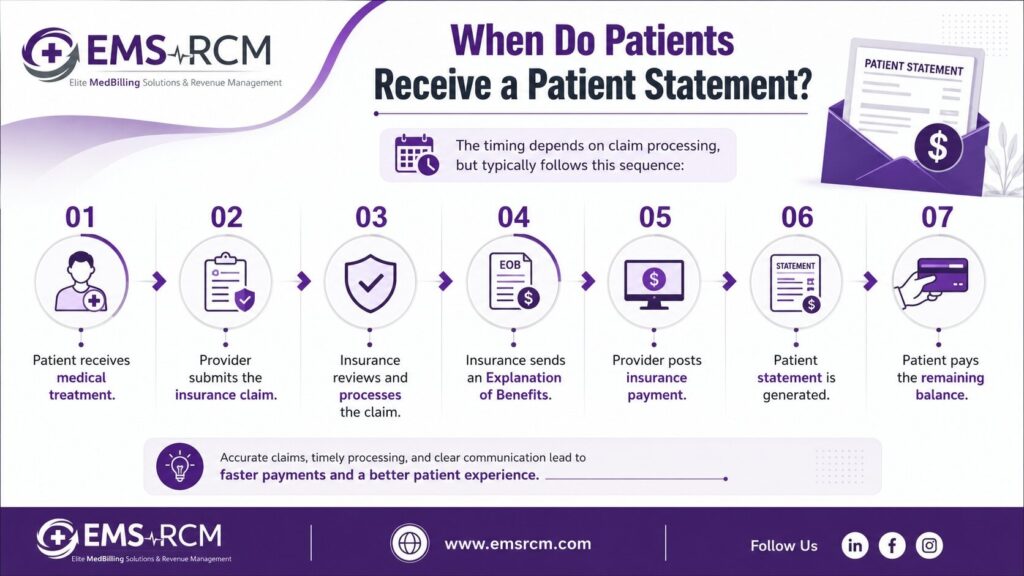
- Patient receives medical treatment.
- Provider submits the insurance claim.
- Insurance reviews and processes the claim.
- Insurance sends an Explanation of Benefits.
- Provider posts insurance payment.
- Patient statement is generated.
- Patient pays the remaining balance.
This process usually takes two to eight weeks, depending on insurance processing times.
Common Reasons You May Receive a Patient Statement
You might receive a patient statement for several reasons:
- Outstanding deductible
- Coinsurance balance
- Copayment due
- Non-covered medical services
- Multiple visits combined into one statement
- Remaining balance after insurance payment
- Missed previous payment
Receiving a patient statement doesn’t necessarily mean an error occurred—it often reflects the normal insurance billing process.
Benefits of Clear Patient Statements
Healthcare organizations increasingly recognize that billing transparency improves both patient satisfaction and financial performance.
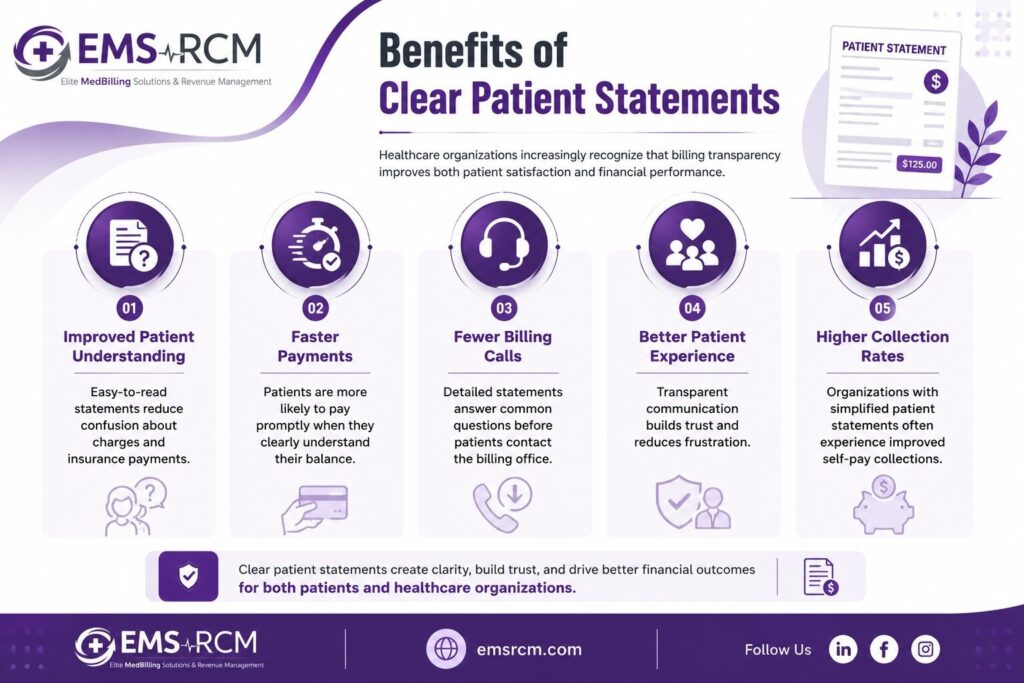
Improved Patient Understanding
Easy-to-read statements reduce confusion about charges and insurance payments.
Faster Payments
Patients are more likely to pay promptly when they clearly understand their balance.
Fewer Billing Calls
Detailed statements answer common questions before patients contact the billing office.
Better Patient Experience
Transparent communication builds trust and reduces frustration.
Higher Collection Rates
Organizations with simplified patient statements often experience improved self-pay collections.
What Makes an Effective Patient Statement?
A modern patient statement should be:
- Easy to read
- Free of medical jargon
- Mobile-friendly
- Clearly organized
- Transparent about charges
- Available digitally
- Secure and HIPAA compliant
- Simple to pay online
Healthcare providers increasingly use digital patient statement solutions that combine printed statements with email, SMS reminders, and online payment portals to create a more convenient payment experience.
Common Mistakes Patients Should Watch For
Before paying a patient statement, review it carefully.
Verify:
- Your name and account information
- Date of service
- Provider name
- Insurance payments
- Remaining balance
- Duplicate charges
- Payment history
If something appears incorrect, contact the provider’s billing office before making payment.
Best Practices for Healthcare Providers
Organizations can improve patient satisfaction and collections by following these best practices:
Use Plain Language
Avoid technical billing terminology whenever possible.
Offer Multiple Payment Options
Include online payments, mobile payments, phone payments, and payment plans.
Send Statements Promptly
Timely billing improves payment rates.
Include Clear Contact Information
Patients should know exactly who to contact with billing questions.
Provide Digital Access
Many patients prefer electronic statements over paper mail.
Automate Follow-Ups
Gentle reminders help reduce overdue balances without creating a poor patient experience.
How Technology Is Improving Patient Statements
Healthcare billing has evolved significantly over the past decade.
Modern patient statement solutions often include:
- Electronic statements
- SMS payment reminders
- Email notifications
- Secure online payment portals
- Payment plan options
- QR code payments
- Real-time account balances
- Automated statement scheduling
- Multilingual communication
These technologies help practices reduce manual work while making it easier for patients to understand and pay their bills.
Challenges Healthcare Providers Face
Managing patient statements can become increasingly difficult as patient financial responsibility continues to grow.
Common challenges include:
- Rising self-pay balances
- Returned mail
- Manual statement generation
- Payment delays
- Confusing billing formats
- High printing and postage costs
- Limited payment channels
Implementing reliable Patient Statement services can help healthcare organizations streamline statement delivery, improve communication, and support a more efficient revenue cycle without sacrificing the patient experience.
Key Takeaways
✔ A patient statement shows the amount a patient owes after insurance processing.
✔ It includes charges, insurance payments, adjustments, and the remaining balance.
✔ A patient statement is different from both a medical bill and an Explanation of Benefits (EOB).
✔ Clear, transparent statements improve patient satisfaction and encourage faster payments.
✔ Digital patient statement solutions make billing more convenient for both patients and providers.
FAQs
Is a patient statement the same as a bill?
Not exactly. A patient statement is a billing summary sent after insurance has processed the claim and typically reflects the patient’s final financial responsibility. It serves as the request for payment in many healthcare settings.
Why did I receive a patient statement after my insurance paid?
Insurance often covers only a portion of healthcare costs. Your patient statement reflects any remaining deductible, copayment, coinsurance, or non-covered services that you’re responsible for paying.
What should I do if my patient statement looks incorrect?
Review the statement carefully and compare it with your Explanation of Benefits (EOB). If you notice discrepancies, contact your healthcare provider’s billing department before making payment.
Can I pay my patient statement online?
Many healthcare providers now offer secure online payment portals, mobile payment options, and payment plans, making it easier to pay balances electronically.
How long should I keep patient statements?
It’s generally recommended to keep patient statements for at least one year, or longer if they’re needed for insurance disputes, tax purposes, health savings account (HSA) documentation, or personal medical records.
Are digital patient statements secure?
Reputable healthcare organizations use encrypted, HIPAA-compliant systems to protect patient information when delivering electronic statements and processing payments.
Conclusion
A patient statement is more than just a request for payment, it’s an important communication tool that helps patients understand their financial responsibility after receiving medical care. Clear, accurate, and easy-to-read statements promote transparency, reduce confusion, and support a better overall healthcare experience.
As patient expectations continue to evolve, clear and convenient billing has become an essential part of the healthcare experience. If your organization is looking to simplify billing communications, reduce administrative burden, and make it easier for patients to pay, exploring a modern Patient Statement solution can be a valuable next step. Learn how EMS RCM‘s Patient Statement services help healthcare providers streamline statement delivery and improve the overall patient payment experience.