

Healthcare providers are under constant pressure to improve financial performance without compromising patient care. That’s where understanding ROI in Medical Billing becomes essential. Whether you run a small practice or manage a large healthcare facility, knowing how to measure and improve your return on investment can directly impact your bottom line.
In this guide, we’ll break down what ROI means in the context of medical billing, why it matters, and how you can maximize it with practical, real-world strategies.
What is ROI in Medical Billing?
ROI (Return on Investment) measures how much profit or financial gain you get compared to the cost of your investment. In healthcare, ROI in Medical Billing evaluates how efficiently your billing processes generate revenue relative to the expenses involved.
Simple Formula:
ROI = (Net Profit / Total Investment Cost) × 100
In Medical Billing Context:
- Investment Cost: Billing staff salaries, software, outsourcing fees, training
- Returns: Reimbursements collected from insurance companies and patients
A positive ROI means your billing system is profitable and efficient. A negative ROI signals inefficiencies, revenue leakage, or operational issues.
ROI Meaning in Healthcare vs. General Business
While ROI meaning is consistent across industries, in healthcare it goes beyond simple profit margins.
| Aspect | General Business ROI | Healthcare ROI |
| Focus | Profit generation | Revenue + operational efficiency |
| Metrics | Sales vs cost | Claims accuracy, denial rates, collections |
| Impact | Financial growth | Financial stability + patient experience |
In healthcare, ROI also reflects how well your billing operations support hospital revenue cycle management, making it a critical performance indicator.
Why ROI in Medical Billing Matters
Understanding ROI isn’t just about numbers, it’s about making smarter business decisions.
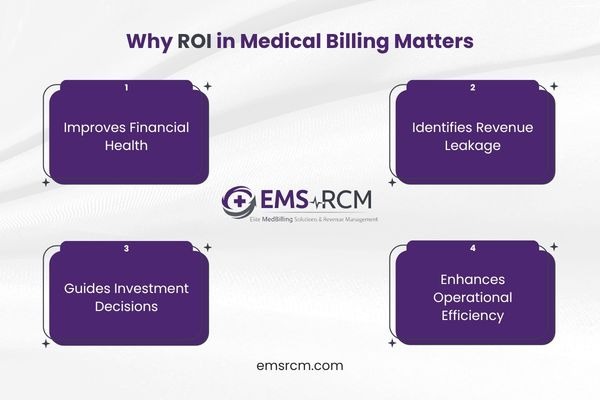
1. Improves Financial Health
A strong ROI ensures your practice is generating more revenue than it spends on billing operations.
2. Identifies Revenue Leakage
Low ROI can highlight issues such as:
- Claim denials
- Coding errors
- Delayed submissions
3. Guides Investment Decisions
It helps determine whether to:
- Hire in-house staff
- Upgrade billing software
- Outsource to a medical billing service
4. Enhances Operational Efficiency
Tracking ROI encourages streamlined workflows, faster reimbursements, and better resource allocation.
Key Factors That Affect ROI in Medical Billing
Several elements directly influence your return on investment:
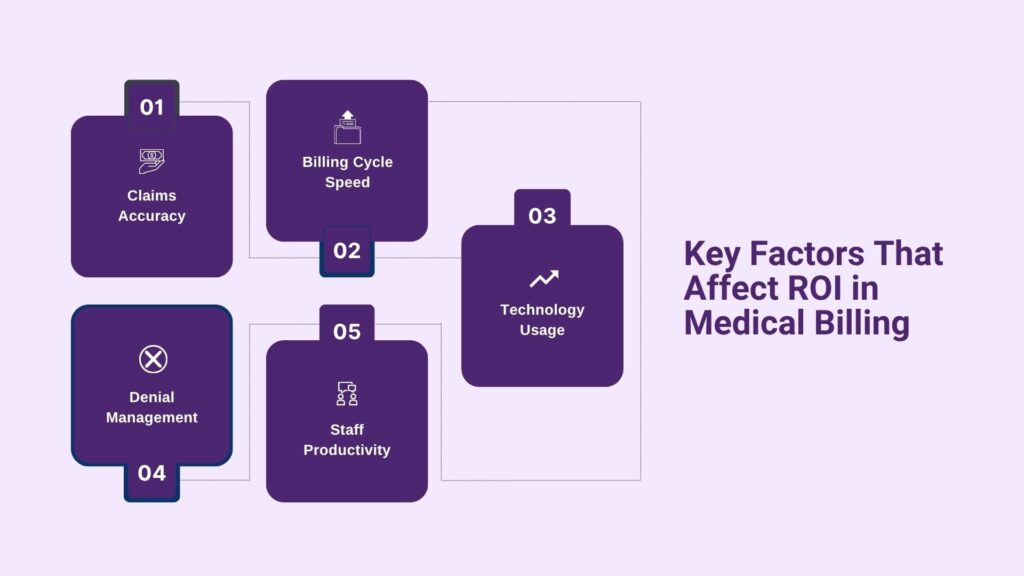
1. Claims Accuracy
Incorrect coding leads to denials and delays, reducing revenue.
2. Denial Management
High denial rates significantly lower ROI. Effective follow-up systems are crucial.
3. Billing Cycle Speed
Faster claim submission and processing improve cash flow.
4. Staff Productivity
Trained billing teams minimize errors and maximize collections.
5. Technology Usage
Modern billing software automates processes and reduces manual errors.
How to Calculate ROI in Medical Billing (Step-by-Step)
Here’s a practical example:
| Component | Amount |
| Total Revenue Collected | $500,000 |
| Billing Costs | $100,000 |
| Net Profit | $400,000 |
ROI = (400,000 / 100,000) × 100 = 400%
This means for every dollar spent, you earned $4 back—an excellent ROI.
Strategies to Improve ROI in Medical Billing
Improving ROI doesn’t always require major investments—small optimizations can make a big difference.
Optimize Coding Accuracy
- Use certified coders
- Stay updated with ICD and CPT changes
Reduce Claim Denials
- Verify patient eligibility in advance
- Submit clean claims the first time
Automate Billing Processes
- Implement EHR-integrated billing systems
- Use AI-based claim scrubbing tools
Outsource Strategically
A reliable medical billing service can reduce overhead costs and improve collections efficiency.
Monitor KPIs Regularly
Track metrics like:
- Days in Accounts Receivable (AR)
- First-pass claim acceptance rate
- Collection ratio
ROI in Medical Terms vs Financial ROI
It’s important not to confuse ROI in medical terms (Return on Investment) with clinical interpretations of ROI (which can sometimes refer to “Region of Interest” in imaging).
In billing and finance, ROI strictly refers to financial performance and efficiency.
Common Mistakes That Lower ROI
Avoid these pitfalls to maintain a healthy return:
- Ignoring denial trends
- Delayed claim submissions
- Poor documentation practices
- Lack of performance tracking
- Over-reliance on manual processes
FAQs
1. What is a good ROI in medical billing?
A good ROI typically ranges from 200% to 500%, depending on practice size and efficiency. Higher ROI indicates better financial performance.
2. How often should ROI be measured?
ROI should be tracked monthly or quarterly to identify trends and make timely improvements.
3. Can outsourcing improve ROI?
Yes, outsourcing can reduce operational costs and improve collections, leading to higher ROI when managed properly.
4. What tools help improve ROI in billing?
Practice management software, automated billing systems, and analytics dashboards are highly effective.
5. Is ROI the only metric that matters?
No, ROI should be evaluated alongside KPIs like denial rate, AR days, and collection efficiency for a complete picture.
Final Thoughts
Understanding ROI in Medical Billing is essential for any healthcare provider looking to stay financially sustainable and competitive. It goes beyond simple profit calculation, it’s a reflection of how efficiently your entire billing operation performs.
By focusing on accuracy, efficiency, and smart investments, you can significantly improve your revenue outcomes while maintaining high-quality patient care.
If you’re looking to improve your billing performance without adding extra workload to your team, Elite MedBilling Solutions can help. As a trusted healthcare revenue cycle management company, we focus on optimizing your revenue cycle, reducing denials, and ensuring faster reimbursements, so you can focus more on patient care and less on administrative stress.Reach out to Elite MedBilling Solutions today to see how a smarter, more efficient billing approach can make a real difference for your practice.