Getting paid in healthcare is not always straightforward. Claims get delayed, denials keep coming back, and billing teams often spend hours fixing issues that could have been avoided. For many providers, this creates a constant cycle of rework that affects both time and revenue.
According to research from the U.S. Department of Health & Human Services, administrative costs make up a significant portion of healthcare spending, much of it tied to billing and claims processing. This is where AI is starting to make a real difference. By reducing manual work and improving accuracy, healthcare revenue cycle management is shifting toward a more efficient and predictable process.
What AI Actually Changes in the Revenue Cycle
AI is not just another tool added to the system. It changes how the revenue cycle works at its core. Instead of relying heavily on manual checks and corrections, AI introduces a more proactive approach where issues are identified early and handled automatically.
In a traditional setup, teams often discover problems only after a claim is denied. With AI, many of these issues are caught before submission. This shift from reactive to preventive workflows helps reduce delays and improves overall efficiency across the revenue cycle.
Where AI Makes the Biggest Impact in Healthcare Revenue Cycle Management
AI does not just improve one part of the process. It supports multiple stages of the revenue cycle, each of which plays a role in how quickly and accurately providers get paid.
Front-End Accuracy (Before the Claim is Created)
The revenue cycle begins long before a claim is submitted. Patient registration, insurance verification, and eligibility checks all happen at the front end. Errors at this stage often lead to denials later
AI helps reduce these errors by verifying patient information in real time. It can check insurance coverage instantly and flag missing or incorrect details before the visit even begins. This ensures that the claim starts on the right footing, which reduces issues downstream.
Mid-Cycle Optimization (During Coding and Submission)
Once services are provided, coding and claim preparation take place. This is another area where mistakes are common, especially when documentation is incomplete or when codes do not align properly.
AI tools can review claims before submission and identify inconsistencies. They can flag incorrect codes, missing modifiers, or incomplete data. By catching these issues early, providers can submit cleaner claims and reduce the chances of rejection.
Back-End Efficiency (After Submission)
After a claim is submitted, the focus shifts to payment tracking and follow-ups. Delays often happen at this stage due to a lack of visibility or slow response times.
AI helps by tracking claim status and identifying delays quickly. It can also prioritize follow-ups based on payment patterns, allowing billing teams to focus on the claims that need immediate attention.
How AI is Reducing Claim Denials at Scale
Claim denials are one of the biggest challenges in healthcare billing. They not only delay payments but also increase administrative work.
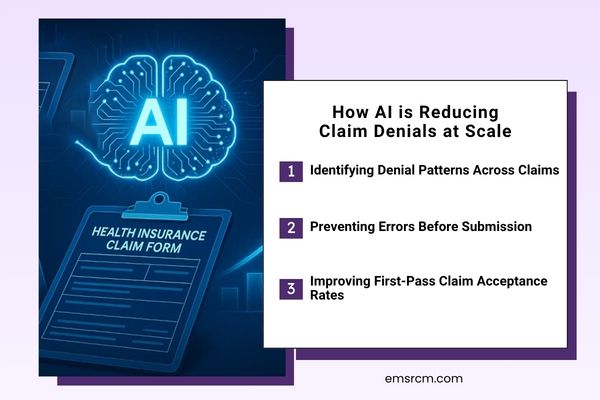
1. Identifying Denial Patterns Across Claims
AI can analyze large volumes of past claims and identify patterns that lead to denials. It can highlight common issues such as missing documentation, incorrect coding, or payer-specific requirements.
This level of insight is difficult to achieve manually. With AI, teams can clearly see what is causing repeated denials and take steps to address those issues.
2. Preventing Errors Before Submission
One of the biggest advantages of AI is its ability to catch errors before a claim is submitted. It can flag missing information, detect inconsistencies, and ensure that all required elements are in place.
This reduces the number of claims that need to be corrected and resubmitted, saving both time and effort.
3. Improving First-Pass Claim Acceptance Rates
First-pass claim acceptance is a key metric in healthcare revenue cycle management. It measures how many claims are approved on the first submission without needing rework.
AI helps improve this rate by ensuring that claims are accurate from the start. Higher first-pass acceptance means faster payments and fewer delays.
How AI Improves Billing Accuracy and Speed
Accuracy and speed are closely linked in the billing process. When claims are accurate, they move faster through the system.
1. Real-Time Claim Validation
AI allows claims to be checked in real time before submission. This means errors can be fixed immediately instead of being discovered days or weeks later.
Real-time validation reduces back-and-forth communication with payers and speeds up the entire process.
2. Automating Repetitive Billing Tasks
Many billing tasks, such as data entry and verification, are repetitive and time-consuming. These tasks also carry a higher risk of human error.
AI can handle these tasks automatically, reducing the workload on billing teams. This allows staff to focus on more important activities like denial analysis and process improvement.
3. Reducing Turnaround Time for Payments
When claims are submitted accurately and on time, payments are processed faster. AI helps ensure that this happens consistently.
By reducing errors and improving submission quality, providers can shorten payment cycles and maintain steady cash flow.
The Financial Impact of AI on RCM
AI does not just improve processes; it also directly impacts financial performance.
Lower Administrative Costs
Manual billing processes require significant time and resources. When errors occur, additional effort is needed to fix them.
AI reduces the need for repeated corrections and lowers administrative costs. This makes the revenue cycle more efficient and cost-effective.
Improved Cash Flow
Faster claim processing and fewer denials lead to quicker reimbursements. This improves cash flow and provides more financial stability for healthcare providers.
In healthcare revenue cycle management, consistent cash flow is essential for maintaining operations and planning for growth.
Better Resource Allocation
When routine tasks are automated, staff can focus on higher-value work. This improves productivity and reduces burnout among billing teams.
It also allows organizations to use their resources more effectively.
How to Start Using AI in Your RCM Process
Adopting AI does not mean replacing your entire system at once. It is more effective to start small and build from there.
Start with High-Impact Areas
Begin with areas that have the most frequent errors, such as eligibility verification or claim reviews. These areas often show immediate improvement and build confidence in the system.
Choose the Right Support System
Working with a trusted healthcare revenue cycle management company or using reliable medical billing services can make the transition easier. These partners can help integrate AI into existing workflows without disruption.
on Gradual Implementation
AI adoption should be a step-by-step process. Start with one area, measure results, and expand gradually. This approach reduces risk and ensures long-term success.
Wrapping Up
AI is changing how healthcare providers manage their billing and payments. It reduces manual work, improves accuracy, and helps prevent common issues before they happen.
As healthcare revenue cycle management continues to evolve, providers who adopt AI-driven solutions will be better positioned to reduce denials, improve cash flow, and build a more efficient revenue cycle.
If your practice is struggling with claim denials, delayed reimbursements, or time-consuming billing tasks, it’s time to take a smarter approach.
Elite MedBilling Solutions provides reliable healthcare revenue cycle management services in Tennessee designed to streamline your billing process from start to finish. With a combination of expert support and AI-driven efficiency, we help providers reduce errors, accelerate reimbursements, and improve overall financial performance.
FAQs
- What is AI in healthcare revenue cycle management?
AI in healthcare revenue cycle management refers to the use of intelligent systems to automate billing tasks, improve accuracy, and reduce claim errors.
- How does AI reduce claim denials?
AI identifies patterns in past claims and flags potential issues before submission, helping prevent common errors.
- Is AI suitable for small healthcare practices?
Yes, many AI tools are scalable and can be used by both small and large practices.
- What part of RCM should be automated first?
Eligibility verification and claim validation are good starting points as they have a direct impact on claim accuracy.
- Does AI replace billing teams?
No, AI supports billing teams by handling repetitive tasks, allowing staff to focus on more important responsibilities.