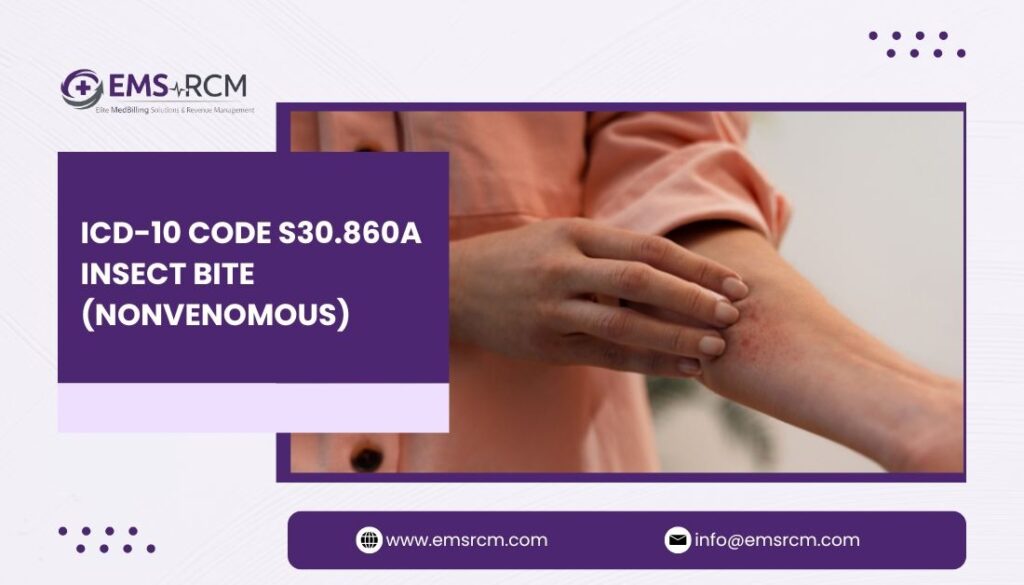
Insect bites are among the most common minor injuries treated in clinical and outpatient settings. However, accurate documentation and coding are essential to ensure proper reimbursement and avoid claim denials. One frequently used code in dermatology and emergency care is ICD-10 Code S30.860A, which represents a nonvenomous insect bite of the lower back and pelvis, initial encounter.
This guide explains everything you need to know about this ICD-10 code, including its meaning, documentation requirements, billing guidelines, and common coding mistakes.
What Is ICD-10 Code S30.860A?
ICD-10 Code S30.860A is used to classify a nonvenomous insect bite affecting the lower back and pelvis area, specifically during the initial encounter for treatment.
Code Breakdown:
- S30 – Injuries to the abdomen, lower back, and pelvis
- .860 – Nonvenomous insect bite of lower back and pelvis
- A – Initial encounter (active treatment phase)
This code is part of the ICD-10-CM classification system used in the United States for diagnosis coding and insurance billing.
Clinical Description of S30.860A
A nonvenomous insect bite typically includes bites from:
- Mosquitoes
- Flies
- Fleas
- Bed bugs
- Ants (non-venomous species)
Common symptoms include:
- Localized redness and swelling
- Mild itching or irritation
- Small raised bump or rash
- Minimal pain or discomfort
Unlike venomous bites or stings, these do not involve systemic toxicity or severe allergic reactions.
When to Use ICD-10 Code S30.860A
Use this code when:
- The patient presents with a fresh insect bite on the lower back or pelvic region
- Treatment is ongoing for the first visit (initial encounter)
- The bite is confirmed as nonvenomous
- No complications like infection or anaphylaxis are present
Do NOT use this code if:
- The bite is venomous (use appropriate venom-related codes)
- Infection or cellulitis has developed
- It is a follow-up visit (use “D” or “S” encounter types)
- The location is different from lower back/pelvis
ICD-10 Coding Guidelines for S30.860A
Accurate documentation is essential for clean claim submission.
Key documentation requirements:
- Exact site of bite
- Type of insect (if known)
- Severity of symptoms
- Encounter type (initial, subsequent, or sequela)
- Any associated complications
Encounter classification:
| Encounter Type | ICD-10 Extension | Meaning |
| Initial visit | A | Active treatment |
| Subsequent visit | D | Routine healing follow-up |
| Sequela | S | Late effects |
Common Coding Mistakes to Avoid
Medical coders often make errors that lead to claim denials. Avoid the following:
- Using unspecified insect bite codes without location details
- Confusing venomous vs nonvenomous bites
- Incorrect encounter selection (A vs D vs S)
- Missing supporting documentation in medical records
- Not linking symptoms like dermatitis or infection when present
Why Accurate Coding Matters in Insect Bite Cases
Proper ICD-10 coding ensures:
- Faster claim approval
- Reduced payer rejections
- Accurate patient medical records
- Better clinical documentation quality
- Compliance with insurance guidelines
Even minor skin conditions like insect bites can impact revenue cycle performance when coded incorrectly.
For healthcare providers looking to improve accuracy and reduce denials, professional Medical Billing Services can streamline documentation, coding, and claim submission processes efficiently.
Related ICD-10 Codes You Should Know
| ICD-10 Code | Description |
| S30.860D | Nonvenomous insect bite, subsequent encounter |
| S30.860S | Sequela of insect bite |
| T63.4 | Toxic effect of insect venom |
| L29.9 | Pruritus, unspecified |
FAQs
1. What does ICD-10 code S30.860A mean?
It refers to a nonvenomous insect bite located on the lower back and pelvis during the initial treatment visit.
2. Is S30.860A used for mosquito bites?
Yes, if the mosquito bite is nonvenomous and affects the specified anatomical region.
3. What is the difference between venomous and nonvenomous insect bites in ICD-10 coding?
Venomous bites may require toxicity-related codes, while nonvenomous bites use localized injury codes like S30.860A.
4. Can S30.860A be used for follow-up visits?
No. For follow-up care, you must use the appropriate subsequent encounter code (S30.860D).
5. What documentation is required for this ICD-10 code?
You need the bite location, insect type (if known), symptom description, and encounter type.
Summary
ICD-10 Code S30.860A plays an important role in documenting and billing nonvenomous insect bites affecting the lower back and pelvic region. Proper use of this code requires accurate documentation, correct encounter selection, and awareness of coding guidelines.
By understanding its structure and application, healthcare providers and coders can ensure smoother claim processing and improved revenue cycle performance.
Accurate coding is the foundation of efficient healthcare billing. If your practice struggles with claim denials or documentation errors, optimizing your coding workflow or partnering with expert billing support can make a measurable difference in revenue and compliance. Partner with Elite MedBilling Solutions to streamline your coding process, reduce denials, and strengthen your practice’s revenue cycle.