
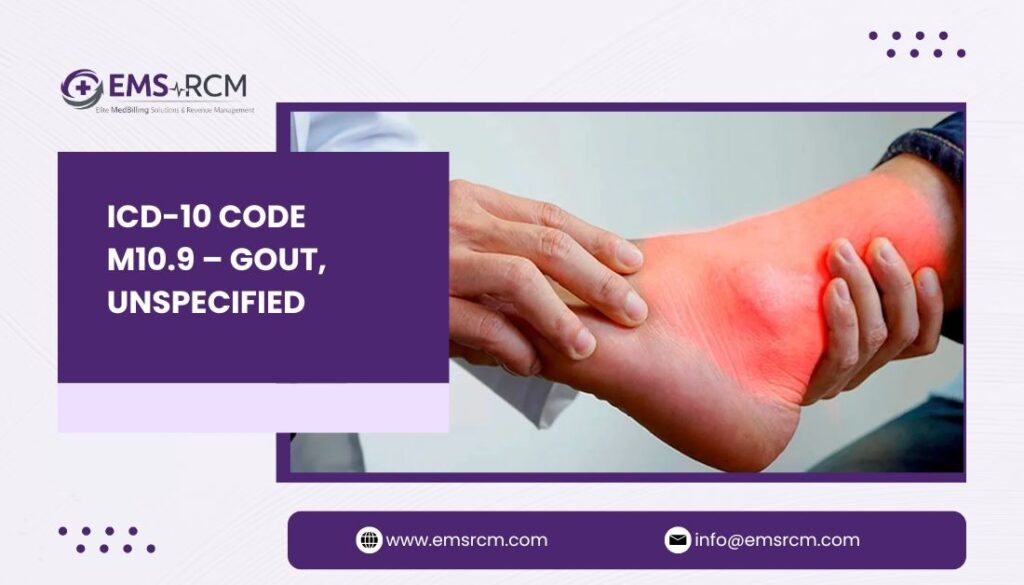
ICD-10-CM Code: M10.9
Diagnosis: Gout, Unspecified
Billable Code: Yes
ICD-9-CM Equivalent: 274.9
What Is ICD-10 Code M10.9?
ICD-10-CM code M10.9 is a billable diagnosis code used to report gout, unspecified for medical billing, insurance claims, and healthcare documentation. This code applies when a provider diagnoses gout but does not document the specific type, cause, or affected joint.
Because M10.9 is billable, it can be submitted for reimbursement when supported by appropriate clinical documentation. However, whenever possible, healthcare providers should document greater specificity to ensure accurate coding, reduce claim denials, and support proper reimbursement.
What Is Gout?
Gout is a common type of inflammatory arthritis caused by excessive levels of uric acid (hyperuricemia) in the bloodstream. When uric acid accumulates, it forms sharp monosodium urate crystals inside joints and surrounding tissues, triggering sudden episodes of intense pain and inflammation.
Gout attacks often develop without warning and commonly affect a single joint, although multiple joints may be involved in advanced disease.
Common Symptoms of Gout
Patients with gout may experience:
- Sudden, severe joint pain
- Swelling around the affected joint
- Redness and warmth
- Joint tenderness
- Limited range of motion
- Recurrent flare-ups
- Chronic joint damage if untreated
Commonly Affected Joints
Although gout can occur in nearly any joint, it most frequently affects:
- Big toe (first metatarsophalangeal joint)
- Ankle
- Foot
- Knee
- Wrist
- Hand
- Fingers
- Elbow
- Shoulder (less common)
Read More: ICD-10 Code W54.0XXA
When Should ICD-10 Code M10.9 Be Used?
Assign M10.9 only when the medical record confirms a diagnosis of gout but does not specify:
- The underlying cause
- Whether the gout is acute or chronic
- The specific joint involved
- The type of gout (such as idiopathic or drug-induced)
If documentation identifies a more specific form of gout, coders should report the corresponding, more detailed ICD-10-CM code instead of M10.9.
Clinical Causes and Risk Factors
Several factors increase the likelihood of developing gout, including:
- Elevated uric acid levels
- Kidney disease
- Obesity
- High-purine diet
- Excessive alcohol consumption
- Diabetes and metabolic syndrome
- Hypertension
- Certain medications (especially diuretics)
- Family history of gout
- Male gender and advancing age
Diagnosis of Gout
Healthcare providers diagnose gout using a combination of clinical evaluation and diagnostic testing, which may include:
- Physical examination
- Medical history
- Serum uric acid testing
- Synovial fluid analysis for urate crystals
- X-rays
- Ultrasound imaging
- Dual-energy CT (DECT) scans in selected cases
Treatment Options
Treatment focuses on relieving pain during acute attacks and preventing future flare-ups.
Common treatment approaches include:
- Nonsteroidal anti-inflammatory drugs (NSAIDs)
- Colchicine
- Corticosteroids
- Uric acid-lowering medications
- Lifestyle modifications
- Weight management
- Dietary changes
- Increased hydration
- Limiting alcohol intake
Documentation Tips for Medical Coders
To improve coding accuracy and reimbursement, providers should document:
- Type of gout
- Specific affected joint
- Laterality (right, left, bilateral)
- Presence of tophi
- Acute or chronic condition
- Underlying cause
- Associated complications
More detailed documentation often supports assignment of a more specific ICD-10-CM code than M10.9.
Read More: Orthopedic ICD-10 Coding Guide
Related Clinical Terms and Synonyms
Medical documentation associated with ICD-10-CM M10.9 may include:
- Gout
- Unspecified gout
- Gouty arthritis
- Hyperuricemic gout
- Gout flare
- Acute gout attack
- Chronic gout
- Tophaceous gout
- Gouty tophus
- Gouty tophi
- Articular gout
- Crystal-induced arthritis
- Monosodium urate crystal arthritis
Examples of Gouty Tophi Documented in Clinical Records
Healthcare documentation may reference gouty tophi affecting various anatomical locations, including:
- Gouty tophus of the left ear
- Gouty tophus of the right ear
- Gouty tophus of the left elbow
- Gouty tophus of the right elbow
- Gouty tophus of the left foot
- Gouty tophus of the right foot
- Gouty tophus of the left hand
- Gouty tophus of the right hand
- Gouty tophus of the left olecranon bursa
- Gouty tophus of the right olecranon bursa
- Gouty tophi involving the heart (rare)
- Multiple gouty tophi
Coding Summary
| Field | Details |
| ICD-10-CM Code | M10.9 |
| Diagnosis | Gout, Unspecified |
| Billable | Yes |
| ICD-9-CM Equivalent | 274.9 |
| Category | Diseases of the Musculoskeletal System and Connective Tissue |
| Use When | Gout is diagnosed but the type or site is not specified |
Summary:
ICD-10-CM code M10.9 is a billable diagnosis code used to report gout, unspecified when the provider confirms gout but does not document the specific type or affected joint. Gout is an inflammatory arthritis caused by the buildup of uric acid crystals in the joints, leading to sudden pain, swelling, redness, and stiffness. Accurate clinical documentation helps ensure proper coding, reimbursement, and may support the use of a more specific ICD-10-CM code when additional details are available.