
If you run a medical practice or work in healthcare administration, you already know how stressful billing can be. Claims get denied, and payments get delayed. Patients leave without paying their balance. The whole process can feel like it is always one step behind.
That is where a good revenue cycle management solution comes in. It helps your organization collect what it is owed without burning out your staff or frustrating your patients. But before you invest in any tool or process, it helps to understand the foundation.
In this blog, we will break down the 4 P’s of revenue cycle management, explain what each one means, and show you how they work together to keep your practice financially healthy.
What is Revenue Cycle Management?
Revenue cycle management, or RCM, is the full financial process a healthcare organization uses to track money owed from the moment a patient books an appointment to the moment the last payment is collected.
It covers everything in between, such as verifying insurance, submitting claims, following up on denials, and collecting patient balances. When any part of this process breaks down, your practice loses money.
According to the Healthcare Financial Management Association (HFMA), hospitals lose an average of 4.8% of their net revenue to claim denials every year. For a mid-sized health system, that adds up to tens of millions of dollars walking out the door annually.
Understanding the 4 P’s is the first step toward stopping that loss.
The 4 P’s of Revenue Cycle Management
The 4 P’s are a simple way to remember the key areas you need to focus on. Let us go through each one.
1. Patient
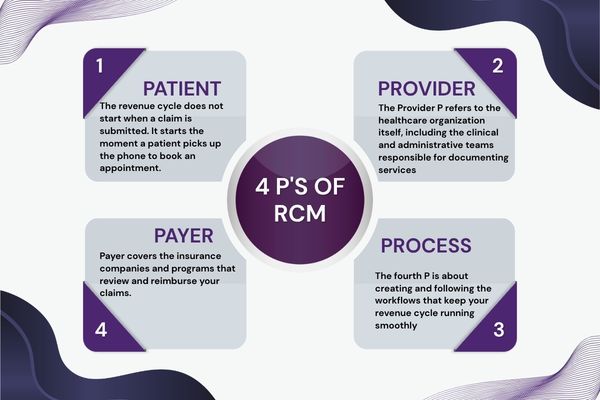
The revenue cycle does not start when a claim is submitted. It starts the moment a patient picks up the phone to book an appointment.
Everything that happens at this stage, collecting the right name, verifying the insurance, getting the authorization, sets the tone for whether that visit ever gets paid. Skip a step here, and you will feel it weeks later when a denial lands in your queue with no clear reason why.
A wrong subscriber number, a misspelled last name, or an authorization that nobody thought to request. These are small mistakes that create big delays. And the frustrating part is that most of them are completely avoidable.
Key tasks in the “Patient” stage include:
- Pre-registration: Collecting patient information before the appointment
- Insurance verification: Confirming active coverage and benefits
- Prior authorization: Getting payer approval for procedures that require it
- Financial counseling: Explaining out-of-pocket costs so patients know what to expect
When patient data is captured cleanly from the start, the rest of the revenue cycle has a much better chance of running without problems. Think of this P as laying the foundation. If it is cracked, everything built on top of it will eventually fall.
2. Provider
The Provider P refers to the healthcare organization itself, including the clinical and administrative teams responsible for documenting services, assigning codes, and submitting claims.
This is where medical coding and charge capture happen. After a patient visit, every service, diagnosis, and procedure has to be translated into the right billing codes. That means the right ICD-10 code, the right CPT code, and physician notes that actually back up what was billed. If any of that does not line up, the payer has every reason to push back.
The tricky part is that mistakes here are not always obvious. A service gets missed in charge capture, and nobody notices. A code gets used that is close but not quite right. The claim goes out, the denial comes back, and by that point, the original visit feels like a distant memory.
Key tasks in the “Provider” stage include:
- Charge capture: Recording every service provided during the visit
- Medical coding: Assigning the right ICD-10, CPT, and HCPCS codes
- Clinical documentation: Making sure physician notes support the codes used
- Claim submission: Sending clean, accurate claims to the right payers on time
Regular coder training and consistent documentation audits are two of the most impactful things a practice can do in this stage.
3. Payer
Payer covers the insurance companies and programs that review and reimburse your claims. Each payer has its own rules, coverage limits, and documentation requirements that your practice must follow.
Healthcare billing is closely tied to payer guidelines. Insurance contracts, Medicare and Medicaid rules, and plan-specific requirements all affect how and when you get paid. If your team does not follow these rules, claims can be denied, delayed, or underpaid.
Strong payer management includes:
- Verifying insurance eligibility before every visit
- Understanding payer-specific billing and coding requirements
- Submitting prior authorizations when needed
- Reviewing payer contracts and reimbursement rates regularly
- Tracking denial patterns by payer to spot issues early
Payers also shape how you communicate with patients. When your team understands coverage details, they can explain costs upfront. This reduces confusion, builds trust, and improves collections at the time of service.
4. Process
The fourth P is about creating and following the workflows that keep your revenue cycle running smoothly. Without clear processes, even the best people can make mistakes. Well-designed processes guide your team, reduce errors, and make sure tasks like claims submission and follow-ups happen consistently.
Some key process checkpoints in RCM include:
- Clean Claim Checks: Verifying claims before submission to reduce rejections
- Denial Management Workflow: Identifying and addressing rejected claims quickly
- Payment Follow-Up Procedures: Ensuring payments are collected on time
- Documentation Review: Confirming all provider notes support the codes submitted
- Claim Resolution Steps: Resolving issues efficiently without backlogs
Strong processes make it easier to spot leaks in the revenue cycle. For example, frequent claim rejections may indicate a gap in the submission workflow, not just a coding issue.
Top revenue cycle management solution providers, like EMC RMC, offer tools that embed these processes into your system. This ensures your team follows each step correctly and gives visibility into what’s happening at every stage, so you can act quickly when something goes off track.
A Quick Breakdown of the 4 P’s in a Revenue Cycle Management Solution
| P | What It Covers | Common Issues | Impact on Revenue |
| Patient | Registration, insurance details, eligibility | Incorrect data, missing coverage info | Claim denials, delayed payments |
| Provider | Documentation, coding, clinical records | Coding errors, incomplete documentation | Underpayments, rejected claims |
| Payer | Insurance review, approvals, reimbursements | Policy confusion, missing authorizations | Payment delays, partial reimbursements |
| Process | Workflows, claim checks, follow ups | Manual errors, poor tracking systems | Revenue leakage, slow collections |
How the 4 P’s Work Together
The 4 P’s are not separate things. They work as one connected system. Great people following weak processes will still make mistakes. Strong policies that no one follows will not protect you. Even the best data is useless if you do not have the right team to act on it.
Here is a simple example of how they all connect:
- Your front desk team verifies insurance before every visit
- They follow your written policy for collecting co-pays at check-in
- Your billing team follows your claim submission process and tracks clean claim checks weekly
- When the rate drops, a trained coder reviews the errors and retrains staff
That loop of following the process, measuring results, correcting errors, and repeating is what keeps a revenue cycle healthy.
Why a Dedicated Medical Billing Solution Matters
For many practices, managing all four P’s manually is just not possible. Staff turnover is high, and payer rules change constantly. And the volume of claims can be overwhelming.
That is why so many providers are turning to a dedicated medical billing solution to handle the heavy lifting. These platforms automate claim scrubbing, flag errors before submission, and give you real-time performance reports.
They also make it easier to train staff, set up workflows, and track compliance. When the right tools support your team, every P becomes a little easier to manage.
In the End
RCM is changing fast. As AI-driven claim scrubbing, predictive denial management, and patient-facing payment portals become more common, healthcare billing is becoming more automated than ever.
But the 4 P’s will always remain relevant. Technology can help you move faster. But without skilled billing teams and coding experts, clear processes, sound policies, and a focus on processes, no tool will fix your revenue cycle on its own.
The practices that will do well in the coming years are the ones that strengthen all four areas together, not just rely on new software. This is where the right support system matters. Working with a team like EMC RMC can help bring structure to your processes, reduce gaps in documentation, and keep your revenue cycle on track while your staff stays focused on patient care.
Frequently Asked Questions
- What is the main goal of revenue cycle management?
The main goal is to make sure a healthcare provider gets paid correctly and on time for every service it delivers. This includes submitting accurate claims, reducing denials, and collecting balances from both payers and patients.
- Can small practices benefit from the 4 P’s framework?
Yes, absolutely. In fact, small practices often benefit the most because they have fewer staff members wearing multiple hats. The 4 P’s give a small team a clear checklist for what to focus on, without needing a large billing department.
- How often should a practice review its RCM performance metrics?
At a minimum, monthly reviews are recommended. However, many practices review key metrics like denial rates and days in A/R on a weekly basis. Real-time dashboards make it easy to spot problems before they become expensive.
- What is the difference between RCM and medical billing?
Medical billing is one part of the larger RCM process. It specifically refers to submitting claims to payers and collecting payment. RCM covers the entire financial journey, from patient registration all the way through final payment and reporting.
- Is a revenue cycle management solution worth the investment?
For most practices, yes. The cost of claim denials, delayed payments, and staff time spent on manual follow-ups often far exceeds the cost of a dedicated RCM platform. A good solution pays for itself through faster payments and fewer errors.