
Healthcare revenue cycle management is essential for the financial stability of medical practices. It depends on how efficiently a healthcare organization bills its patients and gets reimbursements. The process begins before a patient arrives for care and continues until the final payment is collected.
Hospitals and clinics face rising operational pressure due to frequent changes in insurance rules and strict documentation expectations. A structured revenue cycle helps providers improve their cash flow and reduce administrative burden, with each step helping them prevent claim delays or reimbursement losses.
The healthcare revenue cycle comprises ten vital stages. Let’s understand them in detail.
What Is Healthcare Revenue Cycle Management?
Revenue cycle management in healthcare is the financial process that covers the full patient experience lifecycle, from appointment scheduling to final payment. It connects clinical care with billing operations.
The cycle includes patient registration, insurance verification, coding, claim submission, payment posting, and denial management. Each stage must function correctly for reimbursement to proceed without delay.
According to the Centers for Medicare & Medicaid Services, accurate billing documentation is critical for proper reimbursement within federal healthcare programs, emphasizing the need for a structured revenue cycle in healthcare organizations.
The 10 Essential Steps of Revenue Cycle Management in Healthcare
- Patient Registration
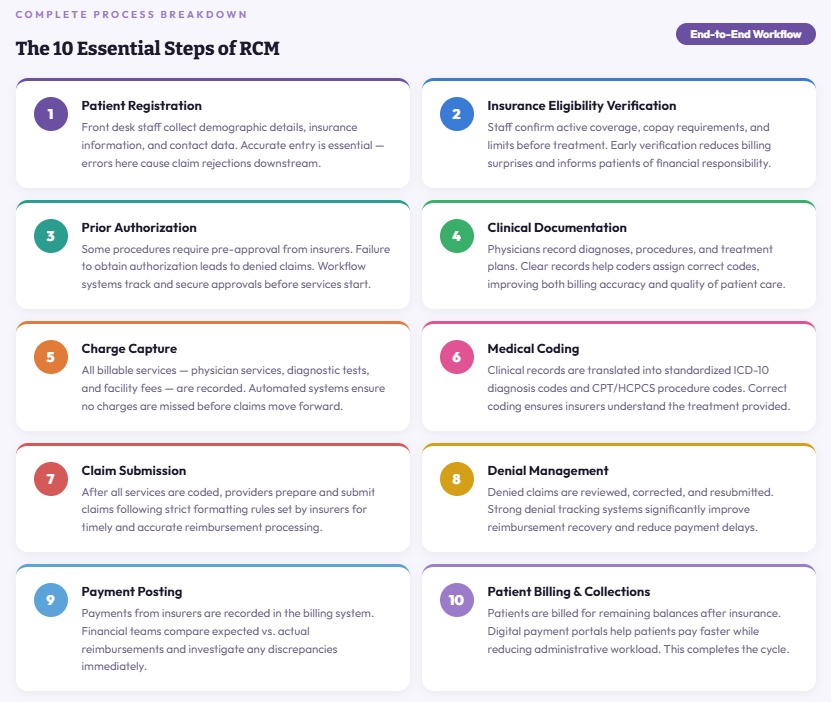
The very first step in the revenue cycle is patient registration. In this stage, the front desk staff collect demographic details, insurance information, and contact data of the patient. Small mistakes at this stage can lead to claim rejection later, which is why accurate data entry is essential for smooth billing. Staff should verify patient identity, policy numbers, and payer information before the visit.
- Insurance Eligibility Verification
Insurance verification confirms whether a patient’s coverage is active. In this stage, staff check benefits, copay requirements, and coverage limits before treatment begins.
Early verification reduces billing surprises. It also allows providers to inform patients about potential financial responsibility before they start taking their services.
- Prior Authorization
Some procedures require approval from insurance providers before treatment. Prior authorization confirms that the insurer will cover the service, and failure to obtain approval can result in denied claims. Many clinics rely on workflow systems to track authorization requests and ensure approval before services start.
- Clinical Documentation
Accurate clinical documentation is necessary to support a claim. Physicians must record diagnoses, procedures, treatment plans, and supporting notes.
Clear records help coders assign correct medical codes. According to the National Institutes of Health, detailed clinical documentation improves the quality of patient care while supporting billing accuracy.
- Charge Capture
Charge capture records all billable services provided during the visit. This includes physician services, diagnostic tests, and facility fees. This step is important because practices may lose revenue if services are not captured correctly. Many practices use automated systems to help ensure that all charges are documented before claims move forward.
- Medical Coding
Medical coding translates clinical records into standardized codes. Coders assign diagnosis codes using the ICD-10 system and procedure codes using CPT or HCPCS classifications.
Correct coding ensures insurers understand the type of treatment provided. Many providers partner with a medical coding company to outsource their coding tasks so that they can focus on patient care.
- Claim Submission
After recording all billable services and converting them into accurate codes, healthcare providers prepare claims following strict formatting rules set by insurers and then submit them.
- Denial Management
Denied claims are a common challenge in healthcare revenue cycle management. Denials may occur due to missing documentation, coding errors, or policy restrictions.
Hospitals and clinics must review denial reasons, correct the claim, and resubmit it. Some outsource this task to companies that offer medical billing services for efficient denial management, which protects revenue and reduces payment delays.
A study published by the Healthcare Financial Management Association highlights that strong denial tracking systems significantly improve reimbursement recovery.
- Payment Posting
After insurers process claims, payments are sent to the provider. Payment posting records these transactions in the billing system.
This step helps financial teams compare expected reimbursement with the actual payment received. Then, they can immediately investigate any discrepancies.
- Patient Billing and Collections
The final stage involves billing patients for remaining balances after insurance payments. Medical practices create patient statements that clearly explain charges and payment options for this purpose.
Many healthcare providers now offer digital payment portals. These systems help patients pay bills faster while reducing administrative workload.
This final step completes the healthcare revenue cycle management process.
Final Word
Revenue cycle management in healthcare keeps practices financially stable, as it makes sure providers are properly reimbursed for the care they deliver. When documentation is accurate, workflows are efficient, and denials are managed proactively, healthcare organizations can maintain steady revenue and reduce administrative disruptions.
If your practice is looking to improve its revenue, EMSRCM can help. Our team supports healthcare providers of all specialties with efficient billing processes and proactive denial management to help maintain a healthy revenue cycle.
Frequently Asked Questions (FAQs)
- What is the main purpose of healthcare revenue cycle management?
The main purpose of healthcare RCM is to make sure healthcare providers are paid for the services they deliver. It manages the process from patient registration and insurance verification to claim submission and payment collection.
- Why is medical coding important in the revenue cycle?
Medical coding converts clinical documentation into standardized billing codes. Accurate coding ensures insurers process claims correctly.
- How can providers reduce claim denials?
Providers can reduce denials by improving documentation quality, verifying insurance eligibility early, and reviewing claims before submission.
- What role does technology play in revenue cycle management?
Technology helps automate billing workflows, track denials, improve claim accuracy, and speed up payment processing.
- Can small practices benefit from revenue cycle management systems?
Yes. Small practices often rely on structured revenue cycle processes or billing partners to manage claims efficiently. Organized workflows help reduce administrative workload and improve reimbursement accuracy.