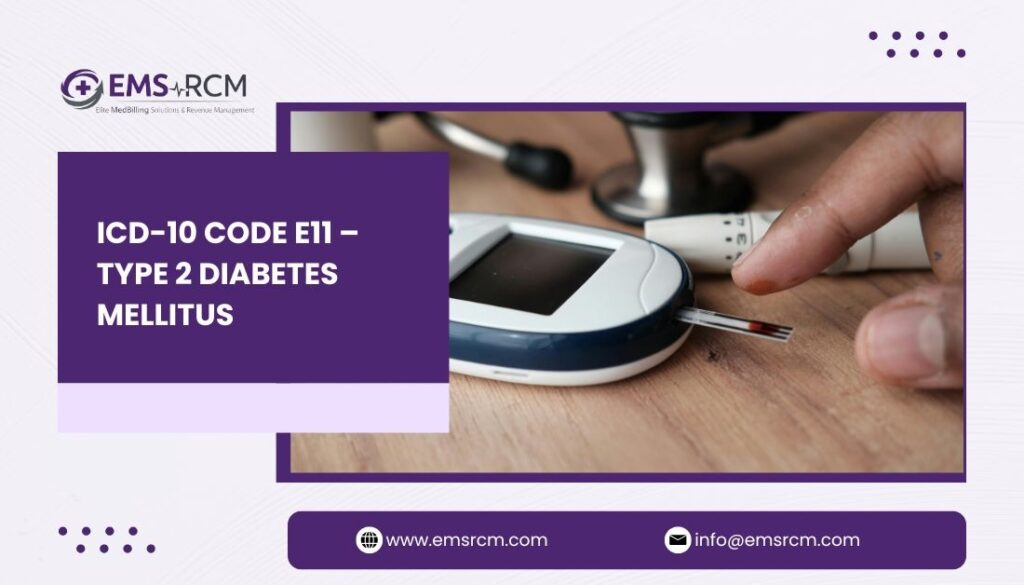
ICD-10 Code E11 refers to Type 2 Diabetes Mellitus, a chronic metabolic condition where the body either does not produce enough insulin or becomes resistant to insulin, leading to high blood sugar (glucose) levels.
This code belongs to the ICD-10 system used globally for medical diagnosis, Medical billing, and healthcare documentation.
Is ICD-10 Code E11 Billable?
- Billable: No
- Category Code: Yes (E11 is a parent code)
The code E11* is non-billable, meaning healthcare providers must use a more specific sub-code (e.g., E11.9, E11.65) for accurate medical billing and reimbursement.
ICD-9 Code Transition
- ICD-9 Code: 250
- Transitioned to ICD-10 for improved specificity and better clinical documentation.
Important Note on Code Confusion
In some cases, healthcare providers may confuse ICD-10 Code I10 with E11, but it is important to note that each code is used for a distinct diagnosis.
- ICD-10 Code I10 is used for high blood pressure (hypertension)
- E11 is the correct code for Type 2 Diabetes Mellitus
Understanding Type 2 Diabetes Mellitus
Type 2 Diabetes is a long-term condition that affects how the body processes blood sugar. It develops when:
- The body becomes insulin resistant, or
- The pancreas does not produce enough insulin
Over time, uncontrolled diabetes can lead to serious complications affecting the heart, kidneys, eyes, and nerves.
Common Symptoms of Type 2 Diabetes
Patients diagnosed under ICD-10 Code E11 may experience:
- Excessive thirst (polydipsia)
- Frequent urination (polyuria)
- Increased hunger (polyphagia)
- Fatigue or weakness
- Unexplained weight loss
- Slow-healing wounds or infections
- Blurred vision
Common Billable Sub-Codes of E11
To ensure accurate coding and reimbursement, providers use specific subcategories such as:
- E11.9 – Type 2 diabetes mellitus without complications
- E11.65 – Type 2 diabetes with hyperglycemia
- E11.40 – Type 2 diabetes with neuropathy
- E11.21 – Type 2 diabetes with nephropathy
These sub-codes provide detailed clinical information and improve claim acceptance rates.
Why Accurate Coding Matters
Using the correct ICD-10 code:
- Reduces claim denials
- Ensures proper reimbursement
- Improves clinical documentation
- Supports patient care tracking and analytics
Incorrect or incomplete coding (like using E11* alone) can lead to billing errors and delays.
Final Thoughts
ICD-10 Code E11 plays a crucial role in diagnosing and documenting Type 2 Diabetes Mellitus, but it must always be paired with a specific billable sub-code for proper use in medical billing.Healthcare providers should stay updated with Medical coding guidelines to ensure compliance, accuracy, and optimal revenue cycle performance.