Orthopedics has the most complex ICD-10 coding system of any medical specialty and that complexity comes from necessity rather than design. Musculoskeletal conditions span nearly every region of the body, and orthopedic care includes everything from minor sprains to multi-site fractures and joint replacements.
Industry estimates suggest that fractures alone account for nearly 300 ICD-10 codes. A major reason for this expansion is laterality, where CMS requires coders to specify right, left, or bilateral for most diagnoses.
This level of detail improves clinical accuracy, but it also creates one of the biggest revenue risks in healthcare billing. A single missing character, incorrect encounter code, or unspecified laterality can delay reimbursement or trigger a denial.
This guide breaks orthopedic ICD-10 coding into two parts:
- Core coding structure and rules
- Common orthopedic conditions by anatomical region
What Are Orthopedic ICD-10 Codes?
Orthopedic ICD-10 codes are standardized diagnostic codes used to classify conditions affecting the musculoskeletal system, including bones, joints, muscles, ligaments, tendons, and connective tissue.
These codes are pulled from two major ICD-10-CM chapters and directly influence:
- Insurance reimbursement decisions
- Medical necessity validation
- Clinical reporting and analytics
- Claims processing outcomes
In orthopedics, accurate coding is not just administrative, it determines whether a claim is paid or denied.
Which ICD-10 Chapters Cover Orthopedic Conditions?
Orthopedic diagnoses are primarily distributed across two ICD-10-CM chapters:
Chapter 13: Musculoskeletal and Connective Tissue Diseases (M00–M99)
This chapter includes long-term, degenerative, and non-traumatic conditions such as:
- Osteoarthritis
- Rheumatoid arthritis
- Osteoporosis
- Tendinitis and bursitis
- Chronic spinal disorders
Chapter 19: Injury, Poisoning, and External Causes (S00–T88)
This chapter covers acute trauma-related conditions, including:
- Bone fractures
- Joint dislocations
- Ligament sprains
- Traumatic tendon injuries
The separation is important because coding rules differ significantly:
- M-codes typically do not require a seventh character
- S-codes almost always require a seventh character for encounter tracking
Read More: ICD-10 Code M94.0 – Chondrocostal junction syndrome [Tietze]
How Is an Orthopedic ICD-10 Code Structured?
An orthopedic ICD-10 code is a 3–7 character alphanumeric sequence where each segment adds clinical specificity.
Example: Chronic Condition
M17.11 – Osteoarthritis of right knee
- M17 = condition category (knee osteoarthritis)
- 1 = primary osteoarthritis type
- 1 = right-sided involvement
Example: Acute Injury
S72.142A – Displaced intertrochanteric fracture of left femur
- S72 = femur fracture category
- 142 = anatomical location and fracture details
- A = initial encounter for active treatment
Even when codes remain billable without full specificity, missing details increase audit risk and reduce reimbursement reliability.
How to Code Orthopedic Diagnoses Correctly
Accurate orthopedic coding depends on four essential documentation components:
- Laterality (right, left, bilateral)
- Encounter type (initial, follow-up, sequela)
- Injury or fracture characteristics
- Post-treatment or recovery status
Each of these elements plays a direct role in claim acceptance and payer validation.
Why Laterality Is Critical in Orthopedic Coding
Laterality is one of the most important requirements in orthopedic coding because most conditions affect paired structures like knees, shoulders, and hips.
Example: Osteoarthritis of Knee
- M17.11 – Right knee
- M17.12 – Left knee
- M17.0 – Bilateral
When laterality is not documented, coders should clarify with the provider rather than defaulting to an unspecified code, which often leads to claim rejection or reduced payment accuracy.
Understanding the 7th Character in Orthopedic Coding
The seventh character is primarily used in injury codes (S-codes) to identify the stage of patient care.
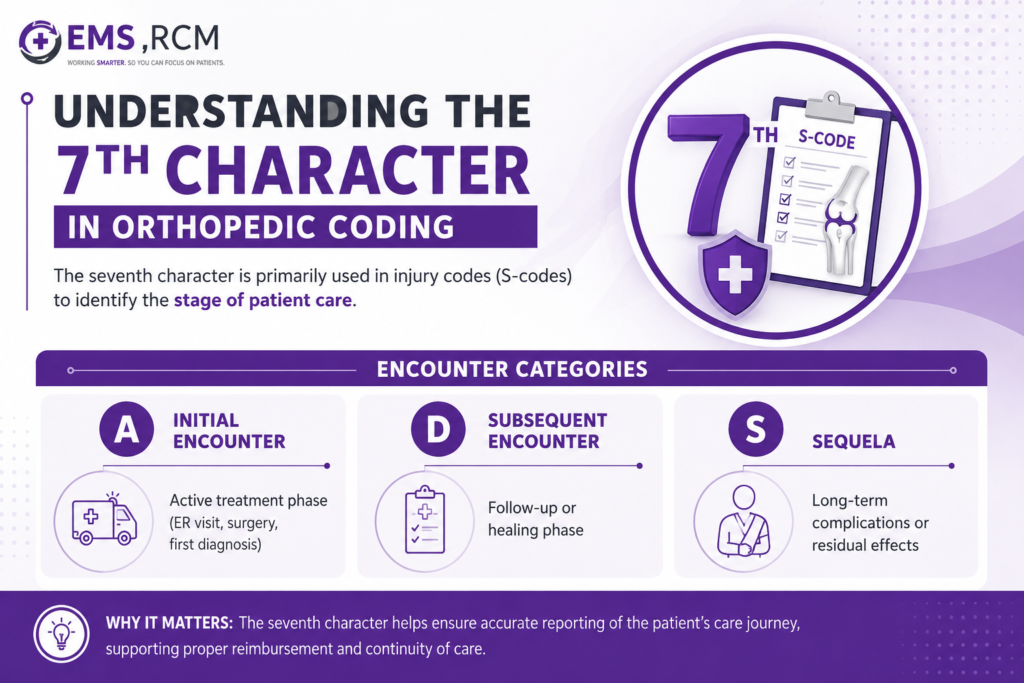
Encounter Categories:
- A – Initial encounter: Active treatment phase (ER visit, surgery, first diagnosis)
- D – Subsequent encounter: Follow-up or healing phase
- S – Sequela: Long-term complications or residual effects
Without the correct seventh character, injury codes are considered incomplete and invalid.
Using the “X” Placeholder in ICD-10 Codes
Some ICD-10 codes require a seventh character but do not have enough defined positions. In these cases, the letter “X” is used as a placeholder to ensure proper formatting.
Incorrect placement of placeholders can shift the encounter character into the wrong position, leading to claim rejection or system errors.
How Orthopedic Fractures Are Coded
Fracture coding is one of the most detailed areas in ICD-10 and requires five key clinical elements:
- Exact anatomical site
- Laterality
- Displacement status
- Open or closed fracture type
- Healing stage or encounter type
Displaced vs. Nondisplaced
- Displaced: Bone fragments are out of alignment
- Nondisplaced: Bone remains properly aligned
Open vs. Closed Fractures
- Closed fracture: Skin remains intact
- Open fracture: Bone breaks through the skin, increasing infection risk
Open fractures typically require more complex treatment and carry higher reimbursement weight.
Gustilo Classification for Open Fractures
The Gustilo system categorizes open fractures based on severity, tissue damage, and contamination level. ICD-10 integrates this classification into fracture coding, especially for long bone injuries.
Higher Gustilo grades indicate more severe trauma and typically justify more intensive clinical intervention.
When to Use Orthopedic Aftercare (Z Codes)
Aftercare Z codes are used only when the patient is in a recovery phase after treatment and no active injury care is being provided.
Common Orthopedic Aftercare Codes:
- Z47.89 – Other orthopedic aftercare
- Z47.1 – Aftercare following joint replacement
Important rule:
Traumatic fracture follow-ups should NOT use Z codes. Instead, they use the original fracture code with a “D” (subsequent encounter).
Read More: ICD-10 Code J20.9: Acute Bronchitis, Unspecified: Billing and Coding Guide
Most Common Orthopedic ICD-10 Conditions
Orthopedic conditions are generally grouped into six major categories:
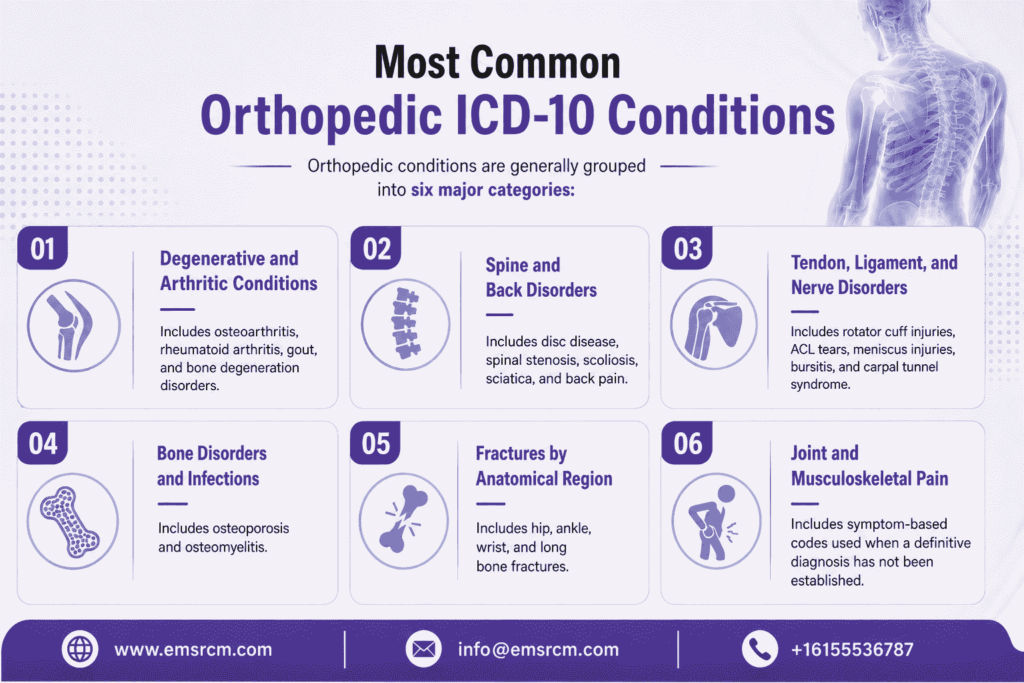
1. Degenerative and Arthritic Conditions
Includes osteoarthritis, rheumatoid arthritis, gout, and bone degeneration disorders.
2. Spine and Back Disorders
Includes disc disease, spinal stenosis, scoliosis, sciatica, and back pain.
3. Tendon, Ligament, and Nerve Disorders
Includes rotator cuff injuries, ACL tears, meniscus injuries, bursitis, and carpal tunnel syndrome.
4. Bone Disorders and Infections
Includes osteoporosis and osteomyelitis.
5. Fractures by Anatomical Region
Includes hip, ankle, wrist, and long bone fractures.
6. Joint and Musculoskeletal Pain
Includes symptom-based codes used when a definitive diagnosis has not been established.
Why Orthopedic Claims Get Denied
Orthopedic claims are highly vulnerable to denial due to coding complexity. The most common reasons include:
- Missing seventh character
- Incorrect or missing laterality
- Insufficient clinical documentation
- Lack of medical necessity support
Even small coding errors can disrupt reimbursement because orthopedic claims often involve imaging, procedures, and post-operative care.
How to Reduce Orthopedic Coding Denials
Reducing denials requires consistent attention to coding precision and documentation quality:
- Ensure maximum code specificity
- Verify all seventh characters before submission
- Perform claim scrubbing prior to billing
- Align provider documentation with ICD-10 requirements
Preventing errors before submission is significantly more effective than correcting denials after they occur.
FAQs
What are the most common orthopedic ICD-10 codes?
Low back pain (M54.50), knee osteoarthritis (M17 series), and fracture-related codes are among the most frequently used.
Is there a single ICD-10 code for orthopedic pain?
No. Pain is coded based on location using M25 (joint pain) and M79 (soft tissue pain) categories.
Which codes are used after orthopedic surgery?
Z47.89 and Z47.1 are commonly used for post-surgical care, while fracture follow-ups use injury codes with appropriate encounter characters.
How often are orthopedic ICD-10 codes updated?
ICD-10 codes are updated annually on October 1 by CMS, which may include additions, deletions, or revisions.