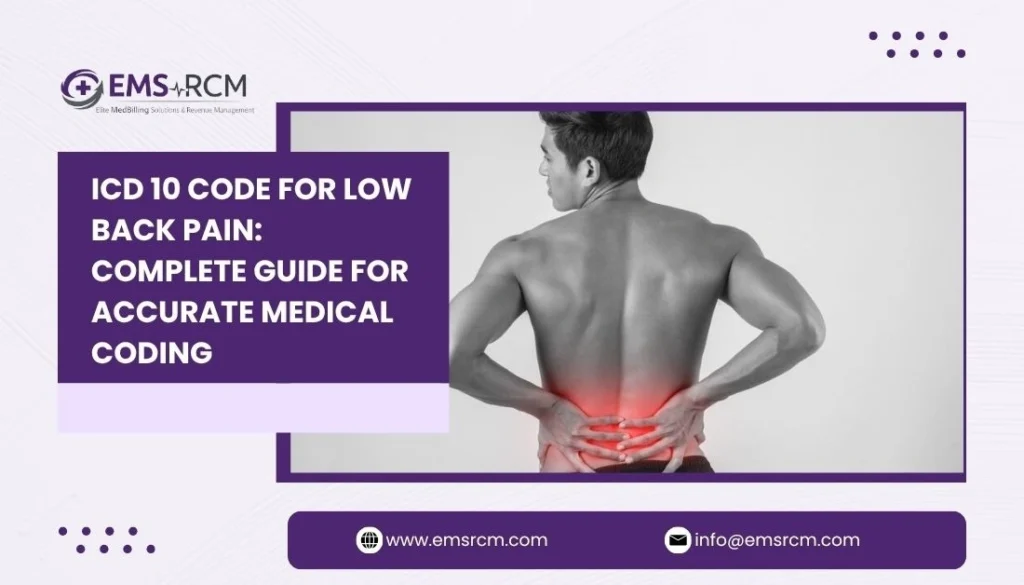
Low back pain is one of the most common reasons patients visit healthcare providers—and one of the most frequently coded diagnoses in medical billing. If you’re searching for the correct ICD-10 code for low back pain, you’re likely aiming to ensure accurate documentation, faster reimbursements, and fewer claim denials.
This guide breaks down the correct ICD-10 codes, when to use them, and how to code low back pain properly based on clinical context.
What Is the ICD-10 Code for Low Back Pain?
The primary ICD-10 code for low back pain is:
M54.50 – Low back pain, unspecified
This code is used when:
- The provider documents low back pain without specifying additional details
- There is no mention of sciatica or underlying condition
Related ICD-10 Codes for Low Back Pain
Depending on the patient’s symptoms and diagnosis, more specific codes may be appropriate:
| ICD-10 Code | Description |
| M54.50 | Low back pain, unspecified |
| M54.51 | Vertebrogenic low back pain |
| M54.59 | Other low back pain |
| M54.40 | Lumbago with sciatica, unspecified side |
| M54.41 | Lumbago with sciatica, right side |
| M54.42 | Lumbago with sciatica, left side |
Key Tip:
Always choose the most specific code available based on provider documentation. Specificity improves claim acceptance rates.
When to Use M54.50 vs. More Specific Codes
Choosing the correct code depends on documentation clarity.
Use M54.50 (unspecified) when:
- No cause is identified
- No mention of nerve involvement (sciatica)
- Early-stage or general complaint
Use more specific codes when:
- Sciatica is documented → use M54.4x
- Vertebrogenic pain is identified → use M54.51
- A distinct cause or variation is noted → use M54.59
Clinical Documentation Requirements
Accurate coding starts with strong documentation. Providers should include:
- Location of pain (lower back, lumbar region)
- Duration (acute vs. chronic)
- Cause (if known, e.g., injury, degenerative disease)
- Associated symptoms (e.g., sciatica, numbness, weakness)
- Laterality (right, left, bilateral)
Example:
“Patients present with chronic low back pain radiating to the right leg consistent with sciatica.”
✔ Correct Code: M54.41
Common Coding Mistakes to Avoid
Even experienced coders make errors with low back pain coding. Here are the most common pitfalls:
- Using M54.50 when a more specific diagnosis is documented
- Ignoring sciatica details (laterality matters)
- Coding symptoms instead of confirmed diagnoses
- Failing to update codes as diagnosis evolves
ICD-10 Coding Guidelines for Low Back Pain
To stay compliant and optimize reimbursement:
- Follow ICD-10-CM Official Guidelines
- Code to the highest level of specificity
- Avoid unspecified codes unless necessary
- Use combination codes when applicable (e.g., back pain + sciatica)
- Ensure documentation supports medical necessity
Why Accurate Coding Matters
Proper ICD-10 coding for low back pain directly impacts:
- Faster insurance reimbursements
- Reduced claim denials
- Compliance with payer regulations
- Better patient record accuracy
- Improved revenue cycle performance
FAQs
1. What is the most commonly used ICD-10 code for low back pain?
The most commonly used code is M54.50 (low back pain, unspecified), especially when no additional details are documented.
2. What is the ICD-10 code for low back pain with sciatica?
Use:
- M54.41 for right-side sciatica
- M54.42 for left-side sciatica
- M54.40 if side is unspecified
3. Can I use M54.50 for chronic low back pain?
Yes, but only if no further specificity is provided. If chronicity or cause is documented, a more specific code may be appropriate.
4. What is vertebrogenic low back pain in ICD-10?
It is coded as M54.51 and refers to pain originating from vertebral endplates, a more specific diagnosis than general low back pain.
5. Is low back pain considered a symptom or diagnosis?
It can be both. If no underlying condition is identified, it is coded as a symptom (M54.50).
Summary
The correct ICD-10 code for low back pain depends on clinical specificity and documentation quality:
- Use M54.50 for general, unspecified cases
- Choose M54.4x codes when sciatica is present
- Opt for M54.51 or M54.59 when more detail is available
Accurate coding ensures better reimbursement, compliance, and patient care outcomes.